

Product Details
* JAMES BARBAR,
FORMERLY THE PROPERTY OF GEORGE, PRINCE OF WALES
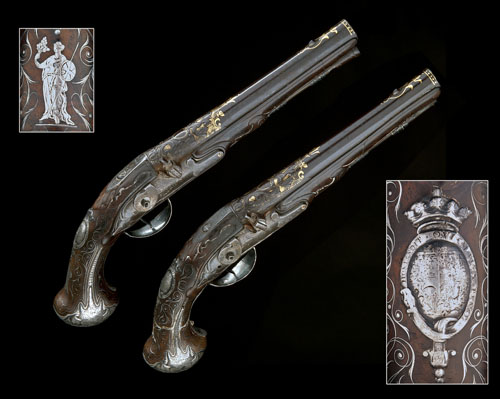
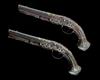
AN IMPORTANT PAIR OF PRESENTATION 20-BORE SILVER-MOUNTED PISTOLS,
circa 1755, converted to percussion from flint by drum and nipple, with slightly swamped 7in. blued barrels (discoloured to brown) carved with raised arabesques at the breech with a gilt-washed background, gilt arabesques extending along the barrel and around the raised fore-sights, gilt band to the muzzles, top tangs engraved with scrolls and lion masks, curved, radiused lockplates signed 'BARBAR' in a banner forwards of the hammer location, pointed tails carved with arabesques (hammers missing from both pistols and some lockwork), walnut fullstocks carved with foliage around the top-tangs and ramrod channels, swollen butts (one broken through and crudely repaired) profusely inlaid with scrolled silver wire, heavy long-eared silver butt-caps embossed with foliage and arabesques, central grotesque masks, the side panels engraved with inverted busts (faint), the wrists bearing the Royal Crest of George, Prince of Wales surrounded by a garter engraved with the French motto 'HONI SOIT QUI MAL Y PENSE' ("shamed be he who thinks evil of it") in silver surmounted with a Ducal crown, an inlaid figure of a standing Britannia below the crest (one Britannia missing), silver trigger-guards with double rolled edges to the bows, engraved with grotesque masks, urn finials, pierced silver sideplates, banded silver ramrod thimbles, one pistol retaining its original leather-tipped ramrod (frozen, the other ramrod also frozen but with tip missing (cracks to both fore-ends, engraving to silver rubbed and faint in places with minor losses throughout)
Provenance: Born in France and christened Jacobus Barbero, James Barbar was apprenticed to his father Lewis Barber for seven years in 1714. It is not certain when Lewis (formerly Ludovicus) moved to England and anglicised the family name, but the earliest guns traced date from 1685-90, and are signed 'Barbar' although the Company of Gunmakers records always quote 'Barber', the English spelling. Not getting off to a good start, Barber was fined heavily for possessing and selling unproved guns in 1698, but by 1704 he was able to become naturalised and purchase his freedom (for £12), at which point he presented his proof piece to the Company of Gunmakers, described in the record books as 'a very fine piece', and was allowed to join them for a fee of 13 shillings and 4 pence. James completed his apprentiship on the 5th April 1722 in the name of Jacobus Barber and was also admitted to the Freedom of the Company.
By 1726 James had opened his own gunmaking business in Portugal Street, Piccadilly, which due to its upmarket location and the trading reputation of his father prospered greatly. In 1739 he purchased a house near the corner of Bond Street and Dover Street, and his father who it is believed had been sharing the premises at Portugal Street up to that time moved to Rupert Street in Whitechapel.
Lewis had been appointed Gentleman Armourer to King George I by warrant in 1717 (with a salary of £31), and was re-appointed in 1727 on the accession of George II. Lewis died early in May 1741 and on the 12th May that year, James was sworn in as Gentleman Armourer in succession to him, where he continued to hold the post until 1762 (the salary remaining unchanged throughout the whole period!).
James died in April 1773 leaving over £8000 in his will, a fitting testament to his prowess as a gunmaker.
The pistols presented here bear the crest of George, Prince of Wales. This crest was only used between 1751-60 at the time when James Barbar was Gentleman Armourer to George II. However, the crest is surmounted with a Ducal, rather than a Royal crown. It has therefore been suggested that these pistols were commissioned to celebrate George's inheritance of the title 'Duke of Edinburgh', which would narrow their date of ordering down to a three week period in 1751. It is not known at this time whether these pistols were made expressly for George, Prince of Wales, or whether they were made under his orders for presentation to a worthy recipient, and will undoubtedly benefit from further research. What is without doubt is that they are of national importance.
Other Notes: George (later King George III) was born in London at Norfolk House. He was the grandson of King George II, and the son of Frederick, Prince of Wales, and Augusta of Saxe-Gotha. As Prince George was born two months premature and was thought unlikely to survive, he was baptised the same day by Thomas Secker, who was both Rector of St James's and the Bishop of Oxford. One month later, he was publicly baptised at Norfolk House, again by Secker. His godparents were the King of Sweden (for whom Lord Baltimore stood proxy), his uncle the Duke of Saxe-Gotha (for whom Lord Carnarvon stood proxy) and his great-aunt the Queen of Prussia (for whom Lady Charlotte Edwin stood proxy).
George grew into a healthy, but also reserved and shy child. The family moved to Leicester Square, where George and his younger brother Prince Edward, Duke of York and Albany, were educated together by private tutors. Family letters show that he could read and write in both English and German, as well as comment on political events of the time, by the age of eight. He was the first British monarch to study science systematically. Apart from chemistry and physics, his lessons included astronomy, mathematics, French, Latin, history, music, geography, commerce, agriculture and constitutional law, along with sporting and social accomplishments such as dancing, fencing, and riding. His religious education was wholly Anglican. At age 10 George took part in a family production of Joseph Addison's play Cato and said in the new prologue: "What, tho' a boy! It may with truth be said, A boy in England born, in England bred". The historian Romney Sedgwick has argued that these lines appear "to be the source of the only historical phrase with which he is associated".
George's grandfather, King George II, disliked the then Prince of Wales and took little interest in his grandchildren. However, in 1751 the Prince of Wales died unexpectedly from a lung injury, and George became heir apparent to the throne. He inherited one of his father's titles and became the Duke of Edinburgh. Now more interested in his grandson, three weeks later the King created the title 'George Prince of Wales'.
In the spring of 1756, as George approached his eighteenth birthday, the King offered him a grand establishment at St James's Palace, but George refused the offer, guided by his mother and her confidant, Lord Bute, who would later serve as Prime Minister. George's mother, now the Dowager Princess of Wales, preferred to keep George at home where she could imbue him with her strict moral values.
In 1759, George was smitten with Lady Sarah Lennox, sister of the Duke of Richmond, but Lord Bute advised against the match and George abandoned his thoughts of marriage. "I am born for the happiness or misery of a great nation," he wrote, "and consequently must often act contrary to my passions." Nevertheless, attempts by the King to marry George to Duchess Sophie Caroline Marie of Brunswick-Wolfenbüttel were resisted by him and his mother; Sophia married the Margrave of Bayreuth instead.
The following year, at the age of 22, George succeeded to the crown when his grandfather, George II, died suddenly on 25 October 1760, two weeks before his 77th birthday
Estimate £3,000-5,000