

Product Details
FORMERLY THE PROPERTY OF H.H THE MAHARAJA OF BARODA
HOLLAND & HOLLAND
A .375 (2 1/2IN.) NITRO EXPRESS 'ROYAL' SIDELOCK NON-EJECTOR DOUBLE RIFLE, serial no. 17757,
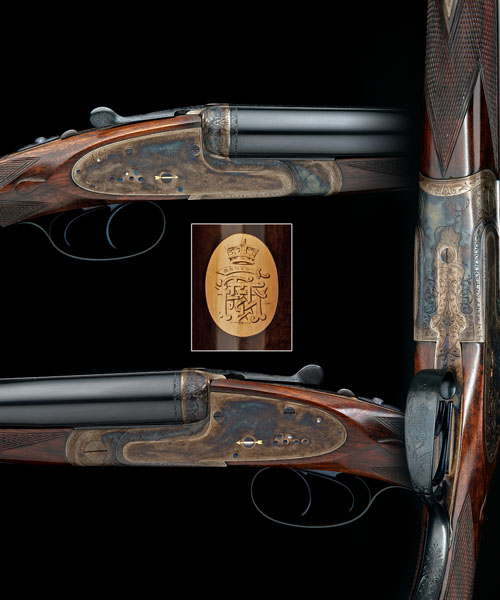
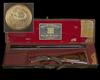
26in. nitro barrels with raised matt sight rib, open sights and three folding leaf sights with silver-inlaid sight lines and marked for 50, 100, 200 and 300 yards, ramp-mounted bead fore-sight with flip-up moonsight, tubes engraved 'HOLLAND & HOLLAND. 98. NEW BOND STREET. LONDON. WINNERS OF ALL THE "FIELD" RIFLE TRIALS. LONDON.', treble-grip action with hidden third bite, removable striker discs, elongated top strap with bolted automatic safety, gold-inlaid 'SAFE' detail, gold arrow cocking-indicators, chequered front trigger, acanthus scroll engraving, the lockplates with naive scenes of lion and tiger stalking their prey, the underside with a stag, the triggerguard and toplever with a tiger, retaining virtually full renewed colour-hardening and finish, 14 1/4in. highly-figured pistolgrip stock with cheekpiece, engraved steel pistolgrip-cap (with trap), sling swivels and including 7/8in. rubber recoil pad, weight 9lb. 9oz., in its leather case with engraved brass escutcheon
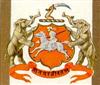
Provenance: The makers have kindly informed us that this rifle was completed as a .375 cordite rifle in March 1903 for 'Baroda'. This refers to the Maharaja of Baroda.
Sayajirao Gaekwad III was born 10th March 1863 and ruled the princely 21-gun salute state of Baroda from 1875 until his death in 1939. He proved to be an industrious and forward-thinking ruler who made many sweeping changes and improvements to the state. This included him embracing steam power and establishing a railway network. He also founded the Bank of Baroda which still trades today as one of India's leading clearing houses.
Sayajirao possessed an interesting amalgam of views; whilst he was a great admirer of the British, and to some extent British rule, he was fiercely protective of his rights and status. He guarded these to the extent that it brought him into conflict with the British Indian Government. He was often at odds with the British on matters of principle and governance and matters reached a climax in 1911 when King George V attended the Delhi Durbar (the first time that a British monarch had travelled to India). Protocol demanded that the Indian heads of state, when presented to the King, bowed three times before retreating without turning their backs. Accounts as to Sayajirao's actions vary, but it is thought that he bowed once in a rather perfunctorily manner, before turning his back on the King and walking away. Whether or not this is true is open to conjecture, but regardless, it had an adverse affect on his relationship with the British Raj which wasn't really healed until 1919 when he was awarded the G.C.I.E. (Grand Cross of the Indian Empire).
He was a man of great culture and actively enjoyed Indian art and music (he was instrumental in the founding of the Academy of Indian Music). He also possessed an impressive collection of precious stones and jewels. These included the 'Star of the South' diamond which weighed in at 262 carats.
After a long and largely successful reign of sixty-three years, Sayajirao Gaekwad III died on 6th February 1939. His grandson and heir, Pratap Singh Gaekwar, became the next Maharaja of Baroda.
Estimate £10,000-15,000
S1