

Product Details
P. BERETTA
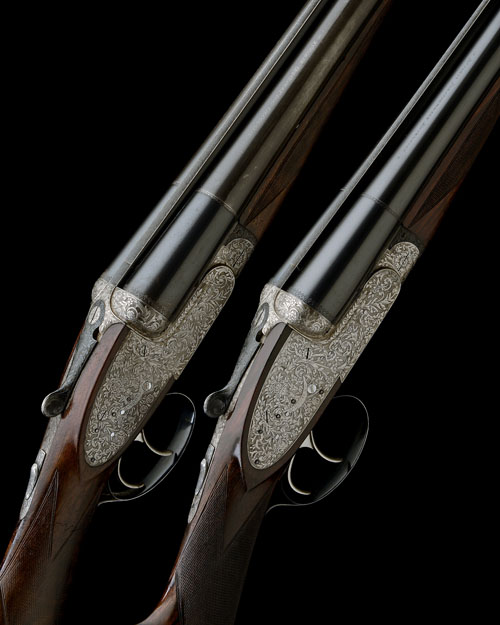
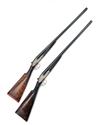
A PAIR OF ANTONELLI-ENGRAVED 12-BORE 'MODEL 450EL' SIDELOCK EJECTORS, serial no. 78542 / 3,
27 1/2in. nitro monobloc barrels with raised matt ribs, 2 3/4in. chambers, bored approx. 1/4 and 1/2 choke, No.2 right wall at 19-, treble-grip actions with hidden third bites, removable striker discs, manual safeties, cocking-indicators, actions, lockplates and furniture engraved with floral and ribbon motifs on a finely matted background, the triggerplates signed 'ANTONELLI', bright and blued finish overall, No.1 with 14 7/8in. well-figured replacement stock (cracked at hand) including 7/8in. rubber recoil pad, No.2 with 14 3/4in. well-figured stock including 1 1/4in. wooden extension, escutcheons on guns and case lid initialled 'A.F.L.', weight 6lb. 15oz. (No.1) and 6lb. 10oz. (No.2), in their slim brass-cornered leather bound oak case
Provenance: The shotguns are accompanied by a letter from the Beretta importers confirming that that were completed in 1953 for Ing. Lago.
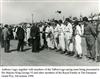
Major Antonio Franco Lago, M.C. was born in Venice, March 1893 but moved from there soon after to Bergamo where his father owned a theatre. The young Lago spent his formative years in the company of thespians, musicians and several leading government officials. He was also introduced to, and became friendly with Benito Mussolini. Once his schooling had finished, Lago attended the Politecnico di Milano where he graduated with the equivalent of a degree in engineering. It was this that set him on the road to great success and influence in the automobile world.
Lago held fairly right-wing views and was one of the founder members of the National Fascist Party in Italy. However, he later became openly critical of the movement which escalated into a violent dispute between him and Mussolini. This culminated in 1919 when three members of the fascist youth movement sought Lago out in a trattoria; they shot the two owners but Lago (who always carried some form of 'protector') threw a grenade at his assailants and ran from the premises. This obviously convinced him that the rift was of a serious nature (it should be remembered that this was an era of volatile politics in much of Europe) and he fled to France as a consequence. His enforced sojourn to Paris was a short one as he then travelled to California where he worked for Pratt and Whitney, best known for their radial aero engines. This too was fairly short-lived (although the relationship with the company continued), and he settled in England during the 1920s where he changed his Christian name to Anthony.
Initially Lago represented the interests of the luxury Isotta-Fraschini motor car company from modest premises on Kilburn High Road, London. It was here that he became close friends with one of his clients, Adam Leigh. With Leigh as financial backer, he then became involved at director level with the company Self-Changing Gears Ltd. owned by Major Walter Wilson and John Siddeley (Leigh had lent him the money to buy the foreign rights to the use of the electro-mechanical 'box). The 'Wilson' gearbox had already established itself in the competition world and was the first successful pre-selector gearbox produced. Lago was a forceful and astute businessman, and he persuaded several makers of the gearbox's merits including the British-owned consortium of Sunbeam Talbot Darracq. Talbot, originally a French marquee, had over-stretched itself during the 20s with its (successful) involvement on the Grand Prix circuit, but Lago was able to convince the British parent company that he could restore the company to financial buoyancy in eighteen months if he was made a director. He made a success of the task employing sound, though hardly revolutionary ideas; namely to reduce overall expenses, build lightweight sporting car and use racing as a means of development and marketing.
He moved back to France in 1933, and the following year was able to negotiate the purchase of Talbot (Sunbeam Talbot Darracq were planning to close the Suresnes factory) at a cost of £63,000, and thus the marquee of Talbot-Lago came into being. However, this was only possible with the financial help of Adam Leigh; so in effect, Lago was more Managing Director of the company than owner.
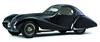
Lago's best known model from the early years is probably the T150 SS. This was designed by Walter Becchia (who later designed the flat-twin 2CV engine) and was most often seen in swooping 'Art Deco' style bodywork from coachbuilders such as Figoni & Falaschi or Pourtout. Talbot-Lago cars were highly successful in competition both pre and post-war, and when Lago announced plans for a V16 engined car for the new 1938 Grand Prix 3ltr ruling, he was able to obtain a 600,000 franc subsidy from France's motor racing federation. However, neither the engine nor the car appeared, and it was rumoured that he had spent the money instead on a plant to build Pratt & Whitney engines under licence. This caused enormous controversy as can be imagined, but he had brought huge motor racing success to France under the Talbot and Talbot-Lago banners, and he was awarded the Legion d'Honneur in recognition of this.
Lago was able to keep the company afloat (though not necessarily solvent) until 1958, despite the fact that it had gone into receivership on four separate occasions. However, with failing health he and Leigh sold the company to the French maker Simca that same year.
Anthony Lago died in Paris two years later and left this pair of shotguns to his friend and business associate, Adam Leigh. He, in turn, passed them on to his son who is now offering them for sale at auction.
Please refer to terms and conditions for commission and shipping information. Please click HERE to view Terms & Conditions.
Estimate £1,500-2,000
S2