

Product Details
EX SMALL ARMS SCHOOL CORPS WEAPONS COLLECTION
SHEPPARD, LONDON
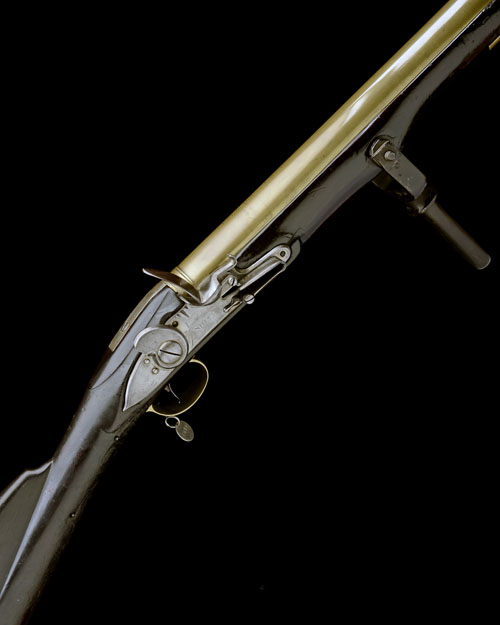
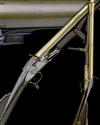
A 1 1/2in. FLINTLOCK BRASS-BARRELLED BLUNDERBUSS OR MUSKETOON FOR THE CUSTOM HOUSE, LONDON, serial no. 'SM57', ref. no. 0145,
circa 1800, with substantial round brass cannon-muzzled 26 1/2in. barrel, the top signed 'CUSTOM HOUSE LONDON', London proofs, moulded bands at breech and muzzle, iron solid top-tang, flat bevel-edged lock signed 'SHEPPARD' (traces of white-metal inlay to signature), large frizzen and slab-sided hammer (broken at neck, top half missing), oversize walnut hand-rail full-stock numbered '104', brass heel-plate, trigger-guard, engraved side-plate and plain ramrod pipe, the underside of fore-end stamped 'SM' over '57' and fitted with a cast iron swivel mount, missing ramrod (some worm to woodwork, fore-end holed in the ramrod channel), the left hand side of butt retaining its Weapons Collection identity plaque, the trigger-guard with identity disk, weight over 21lbs.
Other Notes: Speculation surround the origins of this weapon. It was most likely to have been the property of The Custom House at London and used on a river launch. The London Custom House was situated on the north bank of the Thames in the City of London. It was in use for many centuries and rebuilt on a number of occasions. Until 1814 the Custom House stood in the parish of All Hallows Barking. The site was long known as "Wool Quay", and, from the medieval period, a custom house was necessary there to levy the duty payable on exported wool. Such a building is recorded as early as 1377. The quay and the buildings on it were privately owned. Around 1380, one John Churchman built a custom house there to collect dues for the City of London, and in 1382 the crown came to an agreement to use its facilities. Churchman's custom house remained in use until 1559, the freehold passing through various hands. Its replacement was erected under the direction of William Paulet, Marquess of Winchester, the Lord High Treasurer. A print from 1663 shows it as a three-storey building, with octagonal staircase towers. This structure was destroyed in the Great Fire of 1666. The post-fire replacement was on a rather larger scale, to the designs of Christopher Wren. The original estimate was for £6,000, but the eventual cost was more than £10,000. The new building was short- lived; in January 1715, a fire, which began in a nearby house, damaged the it beyond repair, and a new, larger structure was built to the designs of Thomas Ripley, 'Master-Carpenter' to the board of Customs. This necessitated the acquisition of ground to the north, fronting onto Thames Street, and the east. The main body of the new building, however, had the same plan as Wren's, and may have re-used its foundations, but was of three, rather than two storeys. With the growth of trade, the opening of the docks, and the increases in duties during the Napoleonic wars, larger premises became necessary in the early nineteenth century. To meet this need, a new building was begun to the designs of David Laing in October 1813, on a site immediately to the west of Ripleys's building. Laing had held the position of surveyor to HM Customs since 1810. On 12 February 1814 the old building was destroyed by fire, resulting in the explosion of gunpowder and spirits. As a result papers were retrieved from as far away as Hackney Marshes. The northern front of Laing's new building was plain, but the south front towards the river had wings with Ionic colonnades and a projecting centre section. The attic storey of the latter was decorated with terracotta figures in bas-relief representing the arts and sciences, commerce and industry, and inhabitants of various countries of the world. A clock dial, nine feet in diameter, was supported by colossal figures symbolising Industry and Plenty, and the Royal Arms by figures of Ocean and Commerce. The river front was 488 feet 10 1/2 inches long, and the building cost £255,000. As originally built, the interior contained warehouses, cellars, about 170 offices, and a 'Long room', measuring, 190 by 66 feet. On the ground floor was the "Queen's warehouse", with a rib-vaulted ceiling. The cellars in the basement were fireproof, and used to store wine and spirits seized by the customs. In 1825, the timber pilings which served as foundations for the custom house gave way, leading to a partial collapse of the building. On investigation, it soon became clear that the building contractors Miles and Peto had grossly underestimated the cost of the work and had started to cut corners. The foundations were totally inadequate, even though the ground was known to be unstable. Mile and Peto had used beechwood piles in the foundations rather than the oak that had been specified to counter the ever changing damp and dry conditions, and where the original plans had required nine piles under the twelve piers supporting the Long Room, they had only provided four under some and three under others - with only two piles under two of the piers. The piles were also found to be too narrow and so crooked they had proved impossible to drive in straight. Further investigation showed that instead of paying the one shilling per pile to the pile drivers as they had claimed, Miles and Peto had only paid 3 1/2d per pile and although Miles and Peto had invoiced for a total of 104,000 ft. of piling, it was discovered that only 53,300 ft. had actually been driven. In addition Miles and Peto had charged for certain arches as through they were solid brickwork, on investigation they were found to have been filled with chalk lime and stone waste that would have costed little more than the labour of conveying it there, the south front steps were charged as if solid brickwork but were found to be filled with similar stone waste, and stone paving had been charged as if it were 6 inches thick but was found to be only 4 1/2 inches. Finally, the roof boarding under the slates had been charged for as new and the best materials, but was found to be re-used old boarding! The poor quality of some of the workmanship prompted questions in Parliament in 1825 with the Chancellor of the Exchequer declaring the most scandalous frauds had been practised. Miles and Peto were censured for neglect and poor workmanship that a good builder would carefully have avoided. The central section was rebuilt on new foundations, to a new design with Ionic columns by Robert Smirke, at a cost of £180,000. The building is now used by Her Majesty's Revenue and Customs. A second possibility is that in ancient times the area bordering the River Thames, now modern West Ham was known as 'Custom House London' and eventually became the Victoria Docks in 1846. Despite having a small population, this area had a long history of being used to moor boats, and it is possible that this gun was commissioned to repel French invaders, should they dare venture up the Thames
Please click HERE to view Terms & Conditions.
Estimate £3,000-5,000