

Product Details
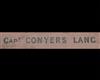
FORMERLY THE PROPERTY OF CAPT. CONYERS LANG
JOHN RIGBY & CO.
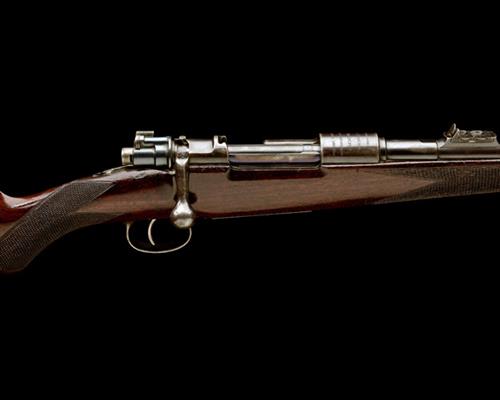
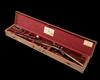
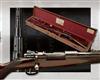
A .275 RIGBY BOLT-MAGAZINE TAKE-DOWN SPORTING RIFLE, serial no. 5420,
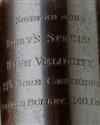
24in. nitro barrel engraved in gothic script 'JOHN RIGBY & CO. 43 SACKVILLE ST. LONDON.', ramp mounted open sights and two folding leaf sights with white metal inlaid sight lines and marked for 100, 300 and 400 yards, ramp-mounted bead fore-sight, receiver ring engraved 'SIGHTED FOR RIGBY'S SPECIAL HIGH VELOCITY .275 BORE CARTRIDGE POINTED BULLET 140 GRS.', mauser action (with thumb cutout) numbered 67415, military style release floorplate, figured semi-pistolgrip stock (cut with 79 trophy notches), sling eyes, 15in. pull including partially ribbed steel buttplate, in its brass-cornered full length leather case with some accessories, the lid outer marked 'CAPT. CONYERS LANG'
Provenance: The makers have kindly confirmed that this gun was delivered to Conyers Lang, on the 28th of February, 1930.
Captain Conyers Lang (1891 - 1969) served in the 1st Battalion Devon Regiment.
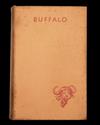
Having fallen for the 'Great African Adventure' of big game hunting, he set himself the task to drive from Cape Town to Cairo in a year, not knowing anything about Africa, its climate or its people. He wrote a book titled "Buffalo", published in 1934, in which he documented his fascinating journey.
In early 1932 he sailed from London to Cape Town, and bought himself a Ford Model A delivery van with which he aimed to drive to Cairo. On his journey of over 13,000 miles he had many great experiences and adventures, including whaling out of Durban, Lion and Buffalo hunting in Portuguese East Africa, fishing in crocodile-infested waters, wildfowling in Northern Rhodesia, and exploring the magnificent landscapes and the tribes of wildest Africa, as well as the lifestyle and living of burgeoning African cities such as Nairobi, Johannesburg and Durban. During his trip he describes hunting with a .275, and the notches carved on the stock would indicate that he had a successful trip with this Rigby rifle, with 51 recorded kills, and mention of many others. The trip was not without danger however, as Conyers Lang also experienced being charged by lionesses, buffalo stampedes, fever, and encounters with hostile locals.
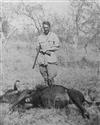
One experience of note (and the one which gave the book its title) took place in the Narok region of Kenya on New Year's Day 1933, where Conyers shot one buffalo, and wounded another as it went after his Masai tracker. In Conyers book he describes the buffalo as '…a wicked pair of eyes blazing with hatred and venom. God! What venom there was in that creatures eyes…'
Conyers was gored in the leg, shoulder and across his lower back, and had his pelvis smashed as the buffalo attacked. He decided the only thing he could do was to try and keep underneath the buffalo to avoid being battered to death. One of his other Masai trackers managed to get a rifle to Conyers, who managed to aim and fire with his left hand, and killed the buffalo. He spent 4 months in hospital in Nairobi and was told he may never walk again.
He returned to England in April 1933 having never made it to Cairo, on the Llanstephan Castle, on which he cast his crutches overboard, firmly resolved that he would walk again, and he did. On his return to England he was asked '…Ah. You must be pleased to have got home after all of your experiences?', in his book his thoughts were '…My heart was in Africa…'
Literature: 'Buffalo' by Conyers Lang, published 1934
Other Notes: This lot is being accompanied by a First Edition copy of his book.
Please click HERE to view Terms & Conditions.
Estimate £3,000-5,000
S1