
Add to calendar

Product Details
* PREVIOUSLY THE PROPERTY OF A. CARTON de WIART
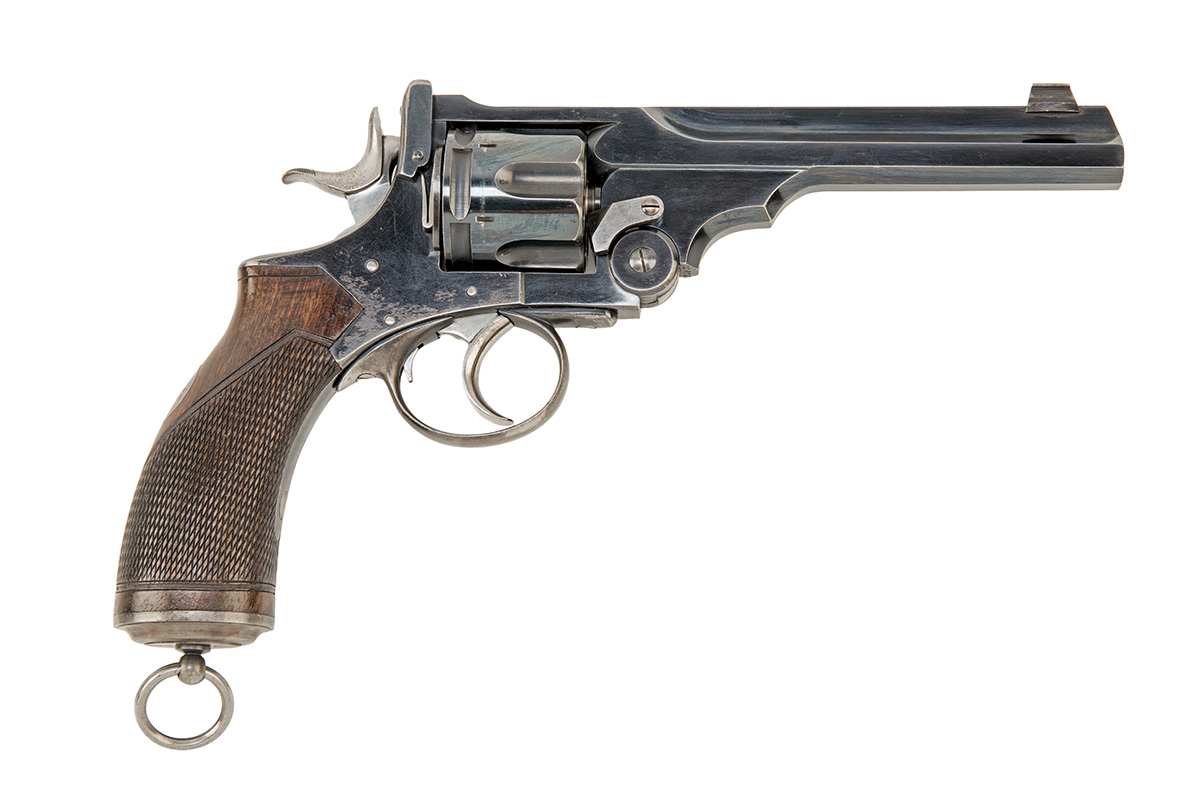
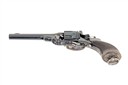
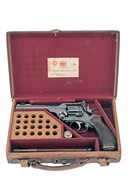
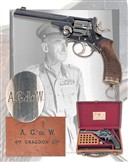
AN IMPORTANT CASED .455 WEBLEY-WILKINSON MODEL 1902 REVOLVER, serial no. 11971 (W593),
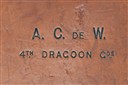
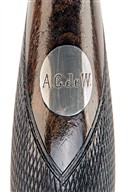
for late 1901, with blued octagonal-form 6in. barrel, raised sighting rib signed 'WILKINSON SWORD CO. PALL MALL, LONDON', dove-tailed beaded blade fore-sight, the left side of barrel throat marked with the Wilkinson 'Star of David' trademark, break open frame with stirrup latch closure, quick-release fluted, auto-ejecting six-shot cylinder, brushed bright hammer and trigger, double action mechanism, chequered walnut one-piece grip Wilkinson numbered 'W593' around the heel and with colour hardened moulded grip-cap with central lanyard ring, the rear of grip with white metal oval escutcheon engraved 'A.C. De W.', guarded trigger, the whole retaining much original finish throughout and in its leather-covered Wilkinson labelled case, the outside of lid marked 'A.C. De W.' over '4TH DRAGOON GDS.', the interior lined in dark red baize and compartmented for the revolver and including a mahogany cleaning rod, nickel oil bottle and tray for ammunition storage, cross-straps to the exterior and brass locking catch (no key), with a letter from the manufacturers.
Provenance: Lt.-Gen. Sir Adrian Paul Ghislain Carton de Wiart, V.C., K.B.E., C.B., C.M.G., D.S.O. was a career soldier who in today's modern language would probably be referred to as a 'machine'. His exploits on the battlefield of three major conflicts and a fair number of lesser-known engagements were the stuff of legend.
Carton de Wiart was born into the Belgian aristocracy on 5th May 1880, the eldest son of L.C.G. Carton de Wiart and Ernestine Wenzig who, although her name suggests otherwise, was of Irish descent. He lost his mother aged six, and soon after his father moved the family to Cairo where he enjoyed useful connections in government circles. Here the young Carton De Wiart learned to speak Arabic before being sent by his new English stepmother in 1891 to The Oratory School, a Catholic public school in Oxfordshire. Following this he went up to Balliol College to read law. However, his desire to serve his country was overwhelming, and in 1899, after only one term, he left Oxford and enrolled in the British Army to fight the Boers, enlisting under a false name, and without the permission or knowledge of his father. It wasn't long before "Trooper Carton" saw action and almost immediately was invalided home after being shot in the groin and stomach. His actions could no longer be hidden from his father who, reportedly, was livid with him for 'dropping out' of university, but finally agreed that he could stay in the army.
After a period of convalescence he returned to South Africa in 1901, presumably with the revolver presented here, having gained a commission in the Second Imperial Light Horse, and later the same year received a regular commission as a 2nd Lieutenant in the 4th Dragoon Guards. His qualities were quickly recognised and by 1904 he had been promoted to supernumerary lieutenant and appointed A.D.C. to Sir Henry Hildyard, the Commander-in-Chief. In his memoirs, de Wiart describes this period leading up to the Great War as his "heyday" and his relatively 'light' duties as A.D.C. enabled him to indulge his love of sport and hunting.
While Europe girded its loins for war, de Wiart was sent to fight the 'Whirling' Dervishes in the Somaliland Campaign, having been seconded to the Camel Corps. It was here in 1914, during an attack against the fort at Shimber Berris, that he was shot twice; losing both an eye and part of an ear. For his actions he was awarded the D.S.O. which was presented in May the following year. In February 1915 he went by steamer to France to re-join his regiment on the Western Front where he fought with great prowess and courage; providing the perfect example of an officer who would never demand that his men should do something he was not prepared to do himself. This was aptly demonstrated during an attack on German positions at La Boiselle on 2nd and 3rd July 1916, when de Wiart's quick thinking and bravery averted the need to retreat. His valour was such that he was awarded the Victoria Cross, the citation reading:
"For most conspicuous bravery, coolness and determination during severe operations of a prolonged nature. It was owing in a great measure to his dauntless courage and inspiring example that a serious reverse was averted. He displayed the utmost energy and courage in forcing our attack home. After three other Battalion Commanders had become casualties, he controlled their commands, and ensured that the ground won was maintained at all costs. He frequently exposed himself in the organisation of positions and of supplies, passing unflinchingly through fire barrage of the most intense nature. His gallantry was inspiring to all."
Carton de Wiart had been shot seven times by the end of the Great War, and lost a hand as well, but returned from hospital each time to lead his men with renewed vigour. He had been promoted steadily during his time in France and ended the war with the temporary rank of Brigadier-General. He summed up his position succinctly, stating: "Frankly I enjoyed the war, and why do people want peace if the war is so much fun."
His inter-war years were spent mostly in Poland where he inherited command of the British-Polish Military Mission from General Botha. Poland was fighting, in turn, the Bolsheviks, Ukrainians, Lithuanians and the Czechs and was sorely in need of help. The then Prime Minister, Lloyd George, was not overly sympathetic to Poland's plight and he and de Wiart had a difficult relationship. The latter's tales of coolness under fire were numerous during his time there and included having his train machine-gunned by Ukrainian troops, acting as a second in a duel involving Baron Carl Gustaf Emil Mannerheim; later President of Finland, and having his position compromised during a gun-running operation from Budapest using stolen Wagon-Lits (sleepers). Perhaps most notably, and soon after he had been appointed A.D.C. to The King with the rank of Brevet Colonel, he was acting as an official observer in August 1920 when the Red Army was threatening to engulf Warsaw. His train was attacked by Russian cavalry and he fought them off from a carriage running-board with his revolver, at one stage falling on to the track only to pick himself back up off the tracks, catch up and re-board the train.
Moving onto 1939, and as Polish resistance crumbled against the German onslaught, de Wiart took the decision to evacuate his mission together with the Polish government and make for the Romanian border, where that country's leader was an allied supporter. The car convoy was strafed by the Luftwaffe and de Wiart fled Romania under a false passport, leaving on the same day that the Prime Minister, Armand Calinescu was assassinated.
De Wiart had barely set foot back in England when he was re-called to the army and immediately was back in action during the early Norwegian campaign when he was tasked with safeguarding the city of Trondheim with the help of the Royal Navy. The mission was not a success and he, together with the whole force, were evacuated to Scapa Flow on 5th May 1940, de Wiart's 60th birthday. After a brief period in Northern Ireland spent bringing the 61st Division up to full strength and ability, he was sent (as an acting Major-General) to Belgrade for talks with the Yugoslav government who were also in imminent threat of invasion. This was not without its fair share of adventure, as during the journey his Vickers Wellington lost both engines and was forced to ditch a mile off the Italian-controlled coast of Libya. In spite of the legacy of numerous injuries, he swam ashore in the company of the surviving crew, but all were captured and sent to various Italian P.O.W. camps with De Wiart ending up at the camp at Castello di Vincigliata. His reputation allowed him to quickly form friendships with a number of senior British officers who had fallen victim to Rommel's early successes in North Africa. He planned and made several escape attempts with his comrades and once managed to evade capture for eight days disguised as an Italian peasant. The scenario is quite remarkable; he had one hand, a patch over an eye, numerous scars and injuries, and spoke not a word of Italian. Not exactly an easy look to blend in with the locals. He didn't spend long back in the camp though. He was taken to Rome in August 1943 for talks with the Italian government who wanted to surrender and throw their lot in with the allies, and they saw de Wiart as a go-between with them and Westminster. The talks were arranged and took place in Lisbon under great secrecy. Carton de Wiart was ordered by his Italian captors to wear civilian clothes but announced in his normal brash fashion that he would only wear properly made gentleman's clothing and not, quote, "some bloody gigolo suit". In his later written memoirs he describes the resulting suit as the best he'd worn in his life! Once in Lisbon he was released and made his way home to England (he had long been a naturalised British subject), arriving back on 28th August 1943.
De Wiart was not a man given to inactivity. This was just as well, because within a month of his return he was summoned by Churchill and informed that he was being posted to China as his personal representative. He was promoted to acting Lieutenant-General and flew out via India on 18th October. He stopped en route to attend the Cairo Conference before spending some while in India where he became close with Sir Claude Auchinleck and the wonderfully eccentric Orde Wingate, creator of the 'Chindits'. He arrived at China's wartime capital, Chongqing, in early December and for the next three years was involved in senior diplomatic and reporting duties. He formed a good relationship with China's nationalist leader, Chiang Kai-shek, and once his job in the Far East was done he was offered a position by Chiang. This he declined, but did return to China during the final months of the Pacific war and was then asked to stay on by Clement Attlee, who had come to power in the 1945 General Election.
Carton de Wiart formerly retired in October 1947 holding the honorary rank of Lieutenant-General. Three years later at the age of seventy-one he married for the second time (his first wife died in 1951) and settled in County Cork. He was now free to return to his love of sport and was soon amongst the snipe and salmon in the surrounding countryside. By his standards he led a relaxed retirement in Ireland and the man who won the V.C., D.S.O., served in the Boer War, First World War and Second World War, was shot in the face, head, stomach, groin, ankle, leg, hip, and ear, blinded in his left eye, survived two plane crashes, tunnelled out of a prisoner-of-war camp, ripped off his own severely injured fingers when a doctor declined to amputate them, finally died of old age at home aged eighty-three, on 5th June 1963. He is buried in Caum Churchyard which backs on to his old house in Killinardish.
Adrian Carton de Wiart was unquestionably a great man and deserves to be remembered as such. Always a military man at heart, he wrote in his memoirs, "Governments may think and say as they like, but force cannot be eliminated, and it is the only real and unanswerable power. We are told that the pen is mightier than the sword, but I know which of these weapons I would choose."
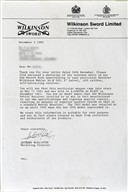
This revolver is accompanied by a letter from Wilkinson Sword Limited dated 1984 which states that this revolver was sold to A. Carton De Wiast (sic) in November 1901 and is a 1902 Model
* Please note this item is subject to 5% VAT on the hammer price (UK Buyers only).
Please click HERE to view Terms & Conditions. Please note all Lots are listed in accordance with UK Law, for overseas buyers, please ensure you are familiar with your relevant local firearms and customs regulations before bidding.
Estimate £3,000-5,000
S5 - Sold as a Section 5 Firearm under the 1968 Firearms Act, Sections 7.3 and 7.1 Eligible.
Unless prior arrangement has been made, two weeks after the Sealed bid sale, all Section 5 (and Section 7.1 / 7.3) items will be moved to a Section 5 carriers where storage charges will be incurred.
Goods will not be released until all outstanding charges have been met. Collection will be by arrangement.