

Product Details
HOUSE OF HABSBURG
LA MARE, VIENNA
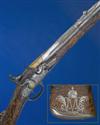
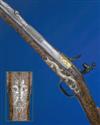
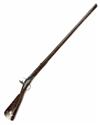
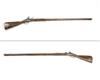
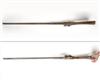
AN EXCEPTIONALLY FINE AND IMPORTANT 28-BORE FLINTLOCK SINGLE-BARRELLED SPORTING GUN MADE FOR THE AUSTRIAN ROYAL FAMILY
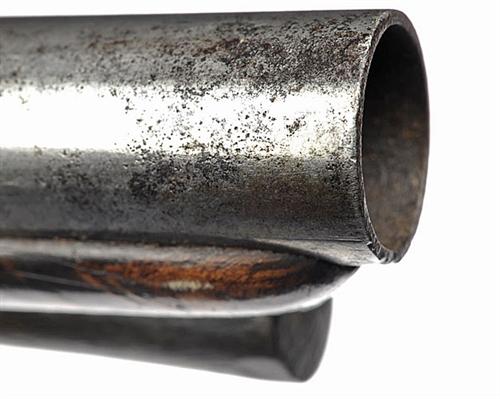
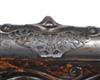
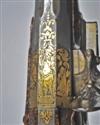
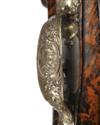
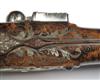
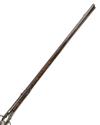
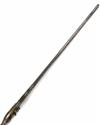
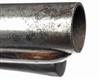
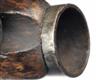
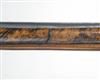
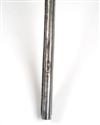
circa 1670, with 38 1/2in multi-stage iron barrel, centre dot and circle engraved medial ridge leading to a carved crescentic foresight, applied carved, twin-eared rearsight surrounded by applied pierced fretwork, gold-washed arabesque flutes chased forwards of the breech, gold damascened vignette of a man at arms in 17th century costume surrounded by martial trophies at breech, gold damascening to tang, strongly radiused lock with pointed tail signed 'LA MARE A VIENNA' in a rococco carved oval near the tail, the lock-plate engraved forward of the hammer with a bearded man riding a mythical beast, finely chased and carved hammer with pierced scroll fretwork to the rear and gilded spindle-screw cover (gilding faded), chased bordered frizzen with a finely carved mythical beast's head near the hinge, carved frizzen spring, exceptionally figured burr-walnut hand-rail full-stock, border-carved around the furniture, inlaid with the House of Habsberg crest in silver to the wrist, two further silver inlaid letter 'M' crowned crests to each side of the stock near the butt, gold and silver wire bordered, border-carved heel-plate engraved with scrolls, flowers and mythical beasts to the base of the spur, the spur en-suite with the barrel ridge and extending nearly the full length of the comb (small loss at tip), fancy rococco carved serpentine silver side-plate with an inlaid gold central ridge with silver wire inlays at the points, highly ornate cast trigger guard with pierced fretwork at the tip of the tang, gold inlaid central ridge, carved with a female bust to the bow, representing the owner, and with silver wire scrolls and feathers inlaid around the carved finial, forend carved with relief scrolls around the fancy carved ramrod throat with further silver wire inlays, finely turned ramrod thimbles, bordered ramrod channel and replacement ramrod (some age cracking and small losses to wood around forend, mild discolouration to iron surfaces
Provenance: This shotgun was built for the Empress Margarita Teresa of Austria, the wife of Emperor Leopold I. She was born of noble birth to King Philip IV of Spain and his second wife, Mariana of Austria in July 1651.
For political reasons she was betrothed while still a child to her maternal uncle Leopold I, the Holy Roman Emperor. However, her father stipulated that she should waive her other succession rights and maintain her place in ascendency to the Spanish throne. After her father's death, in 1666, the fifteen year old Margarita Teresa left Spain to seek solace from her future husband. Their wedding took place in the December of that year in Vienna and their marriage is documented as being a happy one despite the great age difference between them, although she still referred to her husband as 'uncle' after they were wed.
She bore her husband six children although only one of these, Arch-Duchess Maria Antonia, was to survive beyond infancy. The rigours of childbirth coupled with several miscarriages weakened the Empress to the extent that she died, aged only 21, in March 1673.
Other Notes: Jacob la Mort de la Mare was the Imperial Gunmaker - Kaiserlicher Hofbuchsenmacher - to the Austrian Royal Family between 1670 and 1700 although his work is mentioned previously in Paris and Prague as well as Vienna. Surviving examples of his work are rare and this is the only gun made by him outside of the Prince of Lichtenstein's collection and the Museum of Art and History - Kunsthistorisches Museum - in Vienna.
The engraving was designed and carried out in the French manner by Jean Berain the elder, a well-known and respected artisan of the time. He was the artistic 'driving force' in the royal office of the Menus-Plaisirs du Roi and the shotgun shows important styling cues that were highly original. The style at that period was known as Régence, but it became an essential element in what was to become known as Rococo almost a century later.
Estimate £40,000-60,000