

Product Details
STEPHEN GRANT & SONS
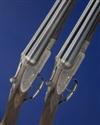
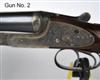
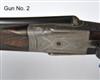
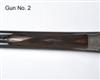
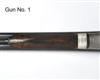
A PAIR OF 12-BORE SIDELOCK EJECTORS, serial no. 7683 / 4,
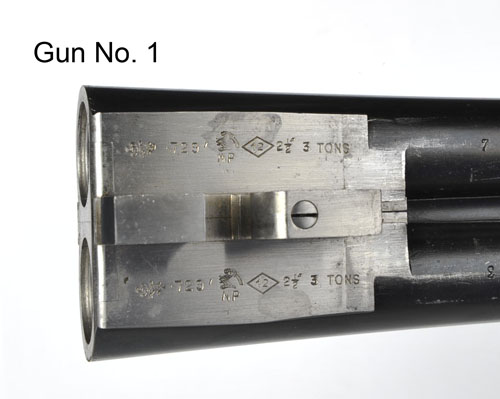
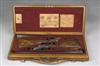
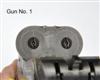
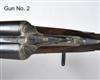
28in. barrels; No.1 nitro reproved, 2 1/2in. chambers, bored approx. imp. cyl. and 1/2 choke, No. 2 replacements by the makers in 1981, 2 3/4in. chambers, bored approx. imp. cyl. and 1/2 choke, the tubes inscribed 'STEPHEN GRANT & SONS. 7, BURY STREET, ST JAMES'S, LONDON, ENGLAND', the ribs scroll engraved at the breech ends and gold-inlaid '1' and '2', fluted fences, automatic safeties with gold-inlaid 'SAFE' details, the toplevers gold-inlaid '1' and '2', removable striker discs, left-handed triggers, best fine acanthus scroll engraving, retaining much original colour-hardening and finish, 15in. figured stocks including 1 1/2in. wooden extensions, cast on for a left-hander, cheekpieces removed and with well executed wooden inserts, weight 6lb. 13oz. (No.1) 7lb. 1oz. (No.2), in their makers brass-cornered oak and leather double guncase with canvas outer. We are kindly informed by the makers that this pair of shotguns were completed May 1908 for Captain S.F. Saunderson.
Provenance:
We are kindly informed by the vendor that this pair of shotguns were given to his father by Captain Sandy Saunderson of the Rifle Brigade.
The Rifle Brigade were attached to the British Expeditionary Force in Northern France at the opening stages of the last war and together with many other units, were driven back to the beaches of Dunkirk by the German offensive. It was here that Saunderson was captured and began a long period of internment in various P.O.W. camps before eventually being moved to Oflag VIIb in Eichstatt. It was at this camp that he met the vendor's father, Captain Ian Weston-Smith, who arrived at Eichstatt after being captured at Salerno. Prior to this, Weston-Smith, Scots Guards, had spent much of the war in the North African theatre where he was wounded and thereafter served as A.D.C. to Lieutenant-General Sir Oliver Leese.
The two men struck up what became a life-long friendship in the camp. Saunderson, an accomplished pianist, somehow persuaded the Red Cross to send him not one, but two concert grand pianos in which he immersed himself when not studying for a law degree and making various escape attempts.
Time passed and with inevitable defeat privately acknowledged by Germany, over 2,000 allied officers were marched east from Oflag VIIb to be held as hostages at Hitler's Eagles Nest retreat. During the march the column was strafed by allied aircraft in a 'friendly fire' incident. During the ensuing confusion, Saunderson and Weston-Smith escaped and arrived at the village of Bohmfeld in need of water. As with many other villages, Bohmfeld was sharply divided between stubbornly loyal Nazis and ordinary war-weary Germans who felt they had been betrayed by Hitler. The land around the village was worked by French P.O.W.s and the pair managed to befriend one of them who, with the help of his employer Frau. Blobb, arranged a hiding place in a barn. Initially the two men were hell-bent on finding their way home but gradually became embroiled in the struggles of the small Bavarian village as the war entered its closing stages. Although Saunderson and Weston-Smith were able to move about freely disguised as French labourers, the dangers were manifold; the indiscriminate allied bombardment drew ever closer and the area was frequently patrolled by S.S. units.
Sixty troops together with their German officer surrendered to the pair and they found themselves in command of an unlikely fighting force, their numbers being swelled by over 300 French labourers. They put aside their own thoughts of escape and led the village through the final, confused days of the war at one stage joining together to repel an attack by a band of S.S. men who were sweeping the area.
Following the end of hostilities Saunderson returned to Germany and the Nuremberg Trials, acting as A.D.C. to Lord Justice Lawrence, and was one of the last men to see Goering. He was chosen, in part, because he spoke fluent German, a fact he had carefully hidden from his captors in the camps. Soon after the trials Saunderson, the vendor's Godfather, moved to America where he spent the rest of his life. He gave these shotguns to Weston-Smith, his friend and companion who then passed then down to his son, the vendor.
Estimate £8,000-12,000
S2