



Product Details
HOLLAND & HOLLAND
A RARE 12-BORE 1911 PATENT 'DUPLEX' CHOKE BOXLOCK EJECTOR 'AERO' GUN, serial no. 83210,
Webley serial number only, 30in. nitro barrels with raised matt rib, open sights removed, tubes engraved 'HOLLAND & HOLLAND. 98, NEW BOND STREET. LONDON. PATENT "DUPLEX" CHOKE, 2 3/4in. chambers, bored approx. 1/2 choke in both, plain, unsigned treble-grip action with removable striker discs, automatic safety with gold-inlaid 'SAFE' detail, 14 3/8in. stock, gold escutcheon stamped with the serial number, weight 7lb. 5oz.;
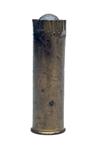
together with an extremely rare example of an original 'Zeppelin' cartridge
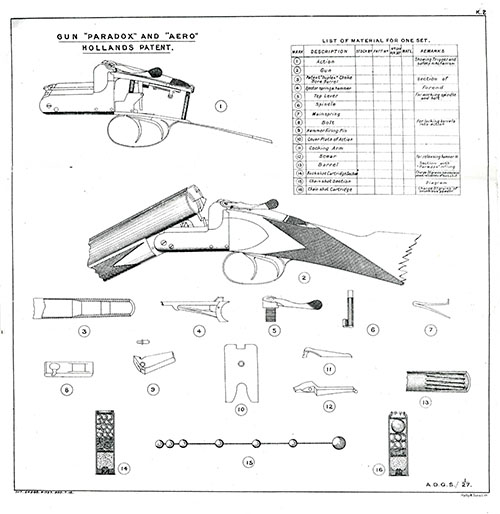
Provenance: Henry Holland and William Mansfield patented the 'Duplex' two stage choke, patent no. 23832 of 27th October 1911, with the primary aim of reducing strain on barrels and lessening muzzle weight.
In 1914, it found a more specific use in combination with another patent by the two men, patent 23196 of 27th November 1914, the 'String of Shot'. Designed for the sole purpose of being used against aircraft or Zeppelins, it comprised of a cartridge with a nucleus of a single solid ball with a variety of smaller shot connected by wire.
Deemed far more effective against fabric and woodwork than a single projectile, and in response to the growing menace of marauding Zeppelin airships, in 1915 Holland & Holland supplied just over one hundred of these 'AERO' guns to the Admiralty for use with the Royal Naval Air Service.
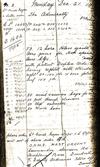
The makers have kindly confirmed that the first order was taken on Monday 21st December 1914, for 'The Admiralty' and consisted of '50 12-bore Hless ejector aero guns for H&H special Aero ctgs with patent Duplex choke boring, sighted with standard sight 50-100yds and one folding leaf, 150 yards' at 22/10/- each, together with an order for 50 mail canvas bags for same, 50 pull though cleaners, 50 clip extractors and 50 wood boxes.
We are indebted to David Winks for the following further research on the subject and for the loan of the various illustrations and adverts (not supplied with the Lot):
In the 1909 January Edition of the magazine 'World's Work' published by Heinemann, featured an article written by F. Talbot entitled Flight in 1909 States', in which the author stated:
"To introduce the aeroplane into explosive shell dropping tactics is a sheer impossibility and to introduce it into a war as a fighting unit, even more remote and the dirigible will be employed for reconnoitering"
He was not quite right, 5 years later the world erupted and the silent killer, the Zeppelin, bought death and destruction to the cities and towns of Great Britain. Holland & Holland fought back.
In 1914 they were marketing an inexpensive 12-bore boxlock ejector with 2 3/4in. chambers, it was made by Webley and named a 'proprietary pigeon gun' but the name was changed to 'The Aero Gun'. It was bored with Holland Mansfield patent No. 23196 Duplex Chokes, ie. two cones. It fired another Holland Mansfield patent no. 23832 - a brass case 12-bore cartridge with one large lead ball followed by six smaller lead balls on an 8in. flexible wire (the idea being to rip the hydrogen filled gas bags off the Zeppelin to bring it down).
The gun was fitted with a small backsight and the barrels engraved with the Holland & Holland name, address and 'PATENT DUPLEX CHOKE'.
In late 1914, The Admiralty placed an order on behalf of the Royal Naval Air Service and the Royal Flying Corps and there are drawings of a gun being fixed at an angle to the struts of a Naval Sopwith Schneider Sea plane.
The Aero gun no. 28310 was sold to the Admiralty and sent to the aeroplane base, Dover in 1915.
There are no recorded instances of the Holland & Holland Aero gun shooting down a Zeppelin.
An incendiary brass cased cartridge 'The Buckingham' was also introduced.
Developed by a Coventry designer, J.F. Buckingham, initial experiments for the .707 inch incendiary - or 'Buckingham-Holland' began circa May 1915. This phosphorus tipped cartridge never gained official approval (although records show that 2000 rounds were supplied to the Royal Naval Air Service in late 1915).
The Buckingham design, however, was extremely successful in .303 calibre and was to remain in service with various modifications for many years.
Literature: 'HOLLAND & HOLLAND - 'THE ROYAL GUNMAKER' - The Complete History' by Donald Dallas
'PARADOX' The Story of Col. G.V. Fosbery, Holland & Holland, and the Paradox. Vol.1 by David J. Baker and Roger E. Lake, Chapter 22
Please click HERE to view Terms & Conditions.
Estimate £1,000-1,500
S2