

Product Details
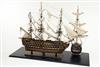
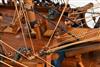
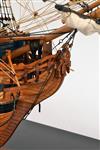
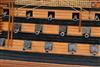
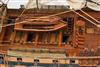
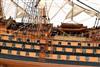
A LARGE, CASED WOODEN MODEL OF NELSON'S FLAGSHIP "H.M.S. VICTORY",
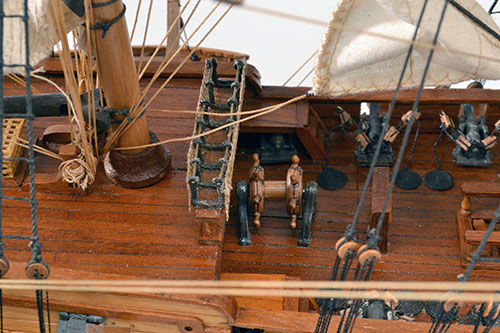
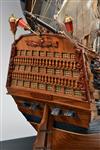
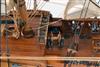
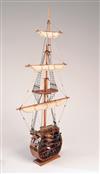
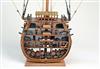
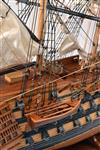
of 40in. overall and approx. 23 1/2in. on the waterline, of individual double-skinned construction on wood frames and floors, detailed fittings in brass, wood, gunmetal and lost-wax castings, fully-rigged with all square and stays'ls present (some heads'ls set along with a scandalised mizzen), full complement of cannon, four wooden jolly boats, reasonably accurate representation of the rig, additional sectioned model of hull athwart the main mast showing detailed hull construction with masts and yards above, the hull in satin varnish, the whole housed in a modern case with moulded perspex cover.
Provenance: By the time Nelson ran up his battle pennants off Trafalgar in 1805, H.M.S. Victory was already forty years old. She was ordered and laid-down in 1759 at a time when the Admiralty favoured smaller, more manoeuvrable ships and Victory, a 104-gun first rater, was a leviathan.
She is best known, of course, as Nelson's flagship but she served with honour before and after and was Keppel's flagship at the Battle of Ushant, Howe's flagship at Cape Spartel and Jervis's flagship at Cape St. Vincent. By the end of 1797 she was no longer considered in good enough order to fight and so the order was given that she should be converted to a hospital hulk to tend to French and Spanish prisoners. It was sheer chance that she was re-commissioned, but after H.M.S. Impregnable was lost off the south coast the Navy was short of a first-rate ship, and so the decision was taken to give her a major refit and press her back into service. So it was that Admiral Horatio Nelson raised his flag aboard her in 1803.
The Battle of Trafalgar took a great toll on Victory and she had to be towed to Gibraltar for repairs before sailing for Greenwich carrying Nelson's body (which was buried at St. Paul's Cathedral on 9th January 1806). The ship saw further use until 1812 when she was permanently moored off Gosport and used as a depot ship. Here she languished for years with her condition gradually deteriorating, although she was used for a time as a floating school for telegraphy. The school transferred to Chatham in 1904 and she was left to rot at her moorings, largely forgotten by both Navy and public. It was only the personal intervention by King Edward VII that prevented her from being scrapped and a body was set-up to save the ship for the nation. She was moved into No.2 drydock at Portsmouth in 1922 and has remained there ever since.
She is the oldest commissioned naval ship in the world, and acts as the flagship to the Admiralty's First Sea Lord.
Please click HERE to view Terms & Conditions.
Estimate £1,800-2,200