

Product Details
PRESENTED BY HRH THE PRINCE OF WALES TO HIS EXCELLENCY THE MAHARAJAH SIR JUNG BAHADOOR G.C.S.I. G.C.B
J. PURDEY
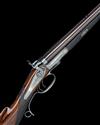
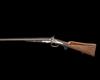
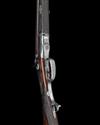
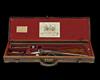
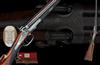
A .500 (3IN.) BLACK POWDER EXPRESS ROTARY-UNDERLEVER DOUBLE HAMMER RIFLE, serial no. 7887,
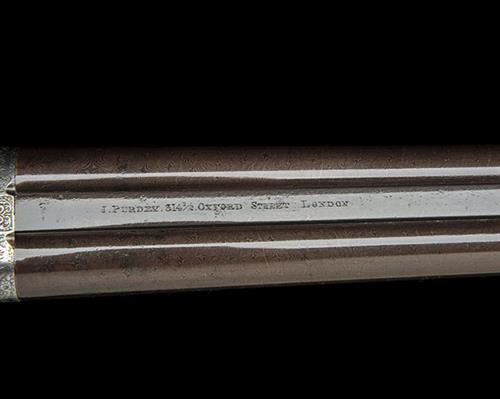
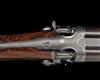
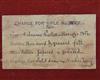
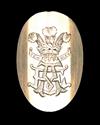
29in. black powder only bold damascus barrels with open sights and two folding leaf sights with gold-inlaid sight lines, bead fore-sight, the rib engraved towards the breech end 'J. PURDEY. 314 1/2. OXFORD STREET. LONDON.', and towards the centre 'TO HIS EXCELLENCY THE MAHARAJAH SIR JUNG BAHADOOR. G.C.S.I. G.C.B. from H.R.H. THE PRINCE OF WALES. K.G. G.C.S.I. 1876', carved percussion fences, nipples marked 'L' and 'R', the top-strap with oval engraved 'PURDEY', non-rebounding island locks with bolted dolphin hammers, the triggerguard forming the rotary underlever and skeletal pistolgrip, light repair to underside of action at knuckle, fine border and acanthus scroll engraving, brushed finish overall, 14 1/2in. replacement stock with chequered steel buttplate and inset with a gold escutcheon inscribed with the Prince of Wales plumed feather crest surmounting the monogram 'A.E.', sling eyes, fore-end with cross-bolt and escutcheon fastening, weight 9lb. 8oz., in an associated brass-cornered oak-lined leather case with some accessories and Purdey Charges label, hand-written for rifle no. 7887
Provenance: The makers have kindly confirmed that the rifle was completed in 1868.
This marks a significant date in the history of James Purdey and Sons, as on 12 February 1868 the Prince of Wales granted James Purdey his Royal Warrant of Appointment (a full ten years before Queen Victoria did so).
The records show four names in the 'owner' column (the first three crossed through) the second being HRH The Prince of Wales' and the fourth being 'Sir Jung Bahadoor'. It is noted that in advance of his pending trip to the subcontinent, Purdey's supplied a number of rifles to the Princes party that were destined to be diplomatic gifts - some of which were sourced from either existing stock or clients. A similar rifle, although with slightly different crest on the escutcheon, is documented on page 107 in Donald Dallas' book on the makers.
In 1875 Prince Albert Edward, the Prince of Wales (and future King Edward VII) set off for an extensive eight month tour of India and the sub-continent. Sport was a prominent feature of the trip, and in 1876 he spent several weeks with Sir Jung Bahadoor hunting in Nepal. Records indicate that the Prince bagged 23 tigers in two weeks, and it is written that he was so bored with the formalities of state that coming to shoot in the Terai was the highlight of his India sojourn. The tour of the sub-continent as a whole was considered a huge success, and as a result Queen Victoria was given the title Empress of India by Parliament.
Maharajah Sir Jung Bahadoor (June 1817 - February 1877) was the ruler of Nepal from September 1846 until his death in 1877, and was the founder of the Rana Dynasty of Nepal, which ruled for over a century.
At age 16 he joined the military service, but lost his job and property when Bhimsen Thapa (former Prime Minister of Nepal, and Jung Bahadoor's relative) fell from power in 1837. With patience and shrewd manoeuvring, he found himself in a position of influence and in 1846 he was ready and prepared to act at the Kot massacre, when Bahadur and his brothers killed around 40 members of the Nepalese palace court (including many of Bahadoor's rivals, and the Prime Minister, a relative of the King) at the palace armoury of Kathmandu. In the immediate aftermath of this Bahadur made himself Prime Minister.
Queen Rajya Laxmi Devi (queen regent, and partially responsible for the massacre) felt that Jung Bahadoor was a threat to her power and conspired to eliminate him, and elevate her son to the throne. This plot failed and resulted in her being stripped of power, and sent into exile along with King Rajendra. The King sought to regain power by forming and mobilizing an army whilst in exile, but Bahadoor learnt of this and captured Rajendra and forced him to abdicate the throne in favour of his son Surendra. Rajendra was kept under house arrest, and King Surendra was allowed no visitors except immediate family, and those Bahadoor allowed. The King wished to abdicate, but Bahadoor would not allow it.
By 1850 Bahadoor had eliminated all of his major rivals, installed his own candidate on the throne, appointed his brothers to important posts, and ensured that major decisions were made by himself. He then took the unprecedented step of travelling to Britain, France and Egypt. Although he unsuccessfully tried to deal directly with the British government while he was there, the main result of the tour was a great increase in goodwill between Britain and Nepal. Indeed, Badahoor was the first prince from the sub-continent to be invited to the court of Queen Victoria. Bahadoor introduced innovations into the bureaucracy of Nepal, and attempted to modernise the country, including the commissioning of the Muluki Ain; a collection of administrative procedures and legal frameworks for interpreting internal laws, which severely limited (but not abolishing) corporal punishment.
During the Indian Mutiny of 1857–58 he sent a contingent of Gurkha soldiers to aid the British, thus establishing a tradition of Gurkha military service in the British army.
Maharajah Sir Jung Bahadoor remained prime minister until 1877, suppressing conspiracies and local revolts and enjoying the fruits of his early successes. He exercised almost unlimited power over internal affairs, taking for his own use whatever funds were available in the treasury.
Literature: James Purdey & Sons Gun and Rifle Makers; Two Hundred Years of Excellence, by Donald Dallas
Please click HERE to view Terms & Conditions.
Estimate £5,000-7,000