

Product Details
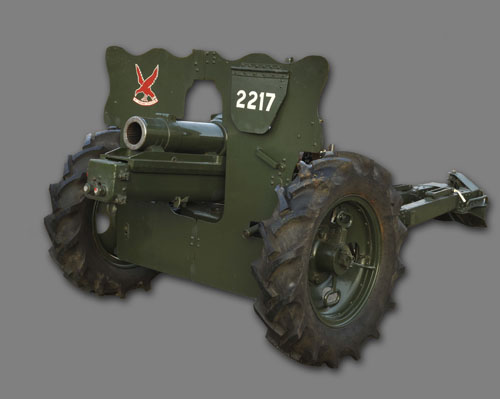
A FULLY RESTORED BRITISH 3.7in. PACK-HOWITZER, no visible serial number,
dated for 1944, with 43 1/2in. barrel, interrupted screw breech and hydropneumatic recoil system, fitted on its original split-trail with pneumatic tyres.
Provenance: The Indian Army first requested a modern mountain gun in 1906 to replace the breech-loading 10 pounder Mountain Gun, which had been hastily developed after the Second Boer War, but had several shortcomings. In particular, the shell weight was seen as too light and the gun lacked any recoil absorber or recuperator, meaning the gun had to be relaid after every shot. However, financial constraints delayed production of the new 3.7 inch weapon until 1915 (As an interim measure, the barrel of the 10 pounder gun was mounted on an updated carriage to produce the 2.75 inch Mountain Gun).
The 3.7 inch Howitzer was first introduced in 1917, and was used in action in that year in Mesopotamia. The 22nd (Derajat) Indian Frontier Force mountain battery arrived in the East Africa campaign on 18 December 1916, when they relieved the 28th Battery which returned to India. They appear to have re-equipped from the 10 pounder Mountain Gun to the 3.7 inch Howitzer while in East Africa, and first used the new weapon in action in an attack on German positions at Medo, 11 April 1918.
The 3.7 inch Howitzer completely superseded the 2.75 inch Mountain Gun following World War I. It was used by Mountain Artillery Regiments of the Royal Artillery and the (British) Indian Army, and saw much service on the North West Frontier of India between the wars.
During World War II, the 3.7in. Howitzer equipped artillery units engaged in the North African Campaign (Tunisia), the Italian Campaign and the Burma Campaign, it was also used in the Netherlands and Ruhr in 1944-45 by units originally destined for Greece. A lightened version was used briefly by Airborne formations. At least one example was supplied to the French Army after 1945; it was captured by the Viet Minh and is on display at the Vietnam Army Museum in Hanoi. The gun was finally declared obsolete by the British Army in 1960, although it had not seen service since 1945.
The howitzer was designed to be broken into eight mule loads, for transport over difficult terrain. The heaviest single section is the interrupted screw breech, which weighs 247 pounds. Given an open gun position, a practiced crew could have this gun unloaded from the mules, reassembled and deployed ready for action in barely two minutes. However, the 3.7 in. Howitzer's adjustable suspension system allowed it to be deployed on almost any position, even those too uneven or with too steep a gradient to allow field artillery to be sited. The process of removing the Howitzer from a position and reloading it onto the gun mules involved much more lifting and securing of loads than deploying it, but can be accomplished in three minutes in favourable conditions and a well trained crew. The Howitzer has a split trail, the first British weapon to do so, which allows firing at very high angles (a useful feature in mountainous terrain). It also has a large rectangular shield to protect the crew from small-arms fire, but this is often omitted to save weight. When it was first introduced, the Howitzer had two wooden wheels and was light enough be towed by two horses. Later marks such as the example here had pneumatic tyres and can be towed by any light vehicle, such as the Bren Carrier or jeep.
This particular gun has been fully restored and painted with its original regimental insignia of the Eighth Army (4th Indian Division) and saw service during the Italian Campaign
Estimate £8,000-12,000
S1