

Product Details
FORMERLY THE PROPERTY OF JACK HARGREAVES O.B.E.
AYA
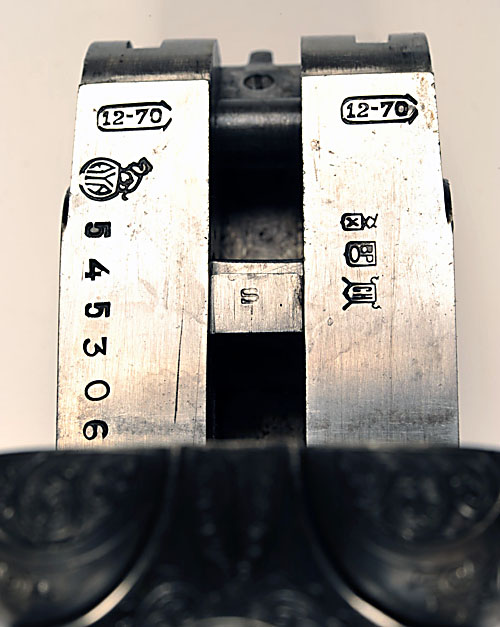
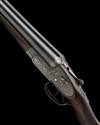
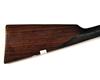
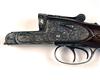
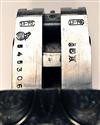
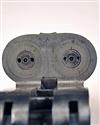
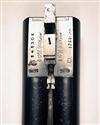
A 12-BORE 'NO.2' HAND-DETACHABLE SIDELOCK EJECTOR, serial no. 545306,
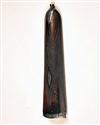
26in. nitro chopperlump barrels, 2 3/4in. chambers, bored approx. 1/4 and 1/2 choke, engraved arcaded fences, automatic safety, hand-detachable lockplates, gold-inlaid cocking-indicators, articulated front trigger, rolled-edge triggerguard, full engraved with scrollwork, retaining traces of original colour-hardening, 14 3/4in. stock, weight 6lb. 10oz., in a brass mounted claret velveteen lined wood case
Provenance: The vendor has informed us that this shotgun was once the property of Jack Hargreaves, the renowned countryman and television presenter. It was purchased by the vendor from a Dorsetshire dealer close to where Hargreaves had lived for much of his later life.
Jack Hargreaves, OBE was born 31st October 1911 in north London but spent much of his youth living with family friends at Burston Hill Farm close to Aylesbury. It was there that he developed a deep and intimate understanding of the countryside that was to lead on to a long and successful career on television. He championed the cause of the British farmer throughout his career and for the last thirty years of his life was a consultant to the National Farmers Union, and was also co-opted on to the Nugent Committee (who looked into the return of M.O.D. land to agricultural use). His enduring interest was to comment without nostalgia or sentimentality on accelerating distortions, perceived or otherwise, in relations between the city and the countryside.
Hargreaves studied at the Royal Veterinary College before earning a living as a copywriter, journalist and script writer for radio and films. By the late 1930s he had established a reputation for his pioneering approaches to radio broadcasting.
By the time the Second World War began, the radio had already been recognised as part of the war effort and so became a restricted occupation that meant an individual wouldn't be called-up for military service. Hargreaves was aware of this and since he wanted to serve he quickly joined-up before events took a hold. He entered the Royal Artillery as a private, quickly became an N.C.O. before entering Sandhurst. On completion of his officer training he was commissioned into the Royal Tank Regiment. He couldn't escape his reputation as a communicator though, and was later recruited to General Montgomery's staff to play a role in the setting up of broadcasting services to the allied forces pre and post D-Day. He briefly held the acting rank of lieutenant-colonel and left the army in 1945 with the substantive rank of major.
Jack returned to his media career after the war and in the 1950s his abilities as a communications manager led to him being recruited to the N.F.U. by Lord Netherthorpe, a passionate lobbyist for farmers. Hargreaves help was enormous and came at a time of seismic change to the rural face of Britain. It was also a time of deep mistrust between the N.F.U. and their members caused, in no small part, by that sea-change.
Hargreaves then became fascinated at the opportunities that the new medium of live television offered and it is for the series 'Out of Town' that he is best remembered. These began in the early 60s with his engaging narrative and the brilliant camera work of Stan Brehaut. The first episode featured Jack and his friend Denys Rayner designing and building a small sailing cruiser. This evolved into the ubiquitous Westerley 22, one of the first of a new breed of yachts that could be towed behind a family car. The series went on to cover many rural topics, many of which were fast disappearing from the scene. These included cart tyring, apple grafting and the cutting and threshing of wheat without a combine; all practises still routinely carried out at the time.
Jack's last move was to Belchawell in Dorset which he blessed for being "just out-of-range of London". It was in the nearby hospital at Dorchester where he died in 1994 and his ashes were scattered on Bulbarrow Hill above his beloved Raven Cottage.
Other Notes: The case was made expressly for this shotgun by a West Country cabinet maker and is of good quality.
Estimate £700-900
S2