

Product Details
WIGHTON, EDINBURGH
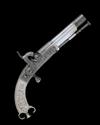
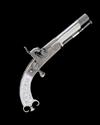
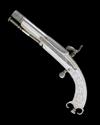
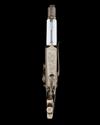
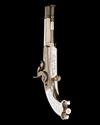
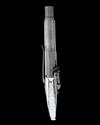
A FINE 80-BORE PERCUSSION SILVER-MOUNTED 'SCOTTISH' BELT-PISTOL FOR HIGHLAND DRESS, no visible serial number,
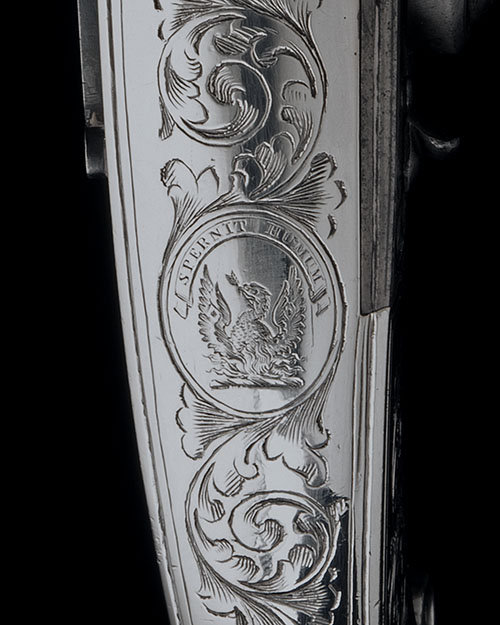
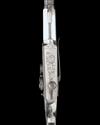
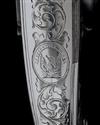
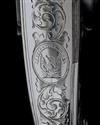
circa 1880, with triple staged 5in. barrel, the muzzle and breech faceted and engraved en-suite, fenced nipple, scroll engraved lock signed 'WIGHTON EDINBURGH' (traces of colour), scroll engraved hammer with sliding safe behind, borderline and scroll engraved solid silver 'ramshorn' butt, the back-strap engraved with a crest within an oval inscribed ''SPERNIT HUMUM' above a phoenix with an arrow in its beak, central screw-out pricker with turned 'thistle' head, small belt-hook to left hand side, ball trigger and turned iron ramrod
Provenance: The distinguishable crest on this Lot is that of Charles Mitchell Esq., of Jesmond Towers, Newcastle
Dr Charles Mitchell (1820 - 1895) was a Scottish engineer born in Aberdeen, who founded major shipbuilding yards on the Tyne. After an engineering apprenticeship in London, he became a ship designer working for John Coutts' Newcastle upon Tyne yard in 1842. He became a shipbuilder in his own right at the Low Walker Yard on the Tyne in 1852. In the 30 years that followed many ships were built under the Mitchell name, both merchant and military for a worldwide client base, including over 90 vessels of various types for Russia. Charles Mitchell, together with his business partner Henry Frederick Swan, set up a shipbuilding yard for the Tsarist government at St. Petersburg. Several warships were built there under the company's direction. In recognition of his services, Tsar Alexander II made Charles a Cavalier of the Order of St. Stanislaus, a rare honour for a British shipbuilder. In 1871, Mitchell was among those greeting the High Admiral, Grand Duke Konstantin at Newcastle Central station, after which the party drove on to Jesmond Towers. The Russian guests had come to visit the Low Walker yard and have a quick tour of the river.
In 1882 the firm merged with William Armstrong and became Armstrong, Mitchell & Co. In that year, they opened a second shipyard to build warships; Low Walker Yard concentrated on merchant shipping and built the world's first ocean-going tanker in 1886.
In 1887 Mitchell commissioned the art nouveau church of St George, Jesmond from Thomas Ralph Spence (1848-1918), secretary of the Newcastle Arts Association. The building is tall and dramatic inside and of excellent workmanship throughout (commented upon by George Bernard Shaw on his visit in the 1890s). The stained glass is especially fine, and the mosaic figures were designed by Mitchell's own son, C.W. Mitchell. The Lewis organ was originally provided with air by two powerful hydraulic engines supplied by Mitchell's neighbour in Jesmond Dene, Baron Armstrong. In Jesmond he gave the land from the Jesmond Towers estate and £30,000 for the construction of the art nouveau St George's church
Charles Mitchell died in August 1895 while still active and going daily to work at the yard In 1897 Armstrong, Mitchell & Co. purchased and amalgamated with Sir Joseph Whitworth & Co. to become Sir W. G. Armstrong, Whitworth & Co. Ltd
Please click HERE to view Terms & Conditions.
Estimate £2,000-3,000