

Product Details
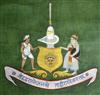
FORMERLY THE PROPERTY OF H.H. THE MAHARANA OF UDAIPUR
JOHN RIGBY & CO.
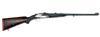
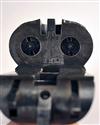
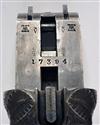
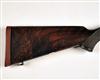
A 7X65R RIGBY & BISSELL 1879 PATENT SINGLE-TRIGGER SIDELOCK EJECTOR / NON-EJECTOR DOUBLE RIFLE, serial no. 17394,
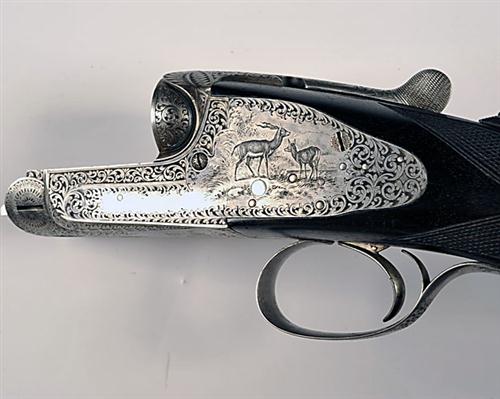
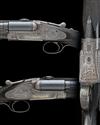
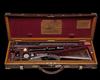
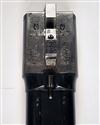
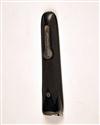
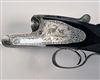
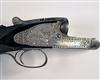
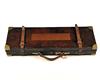
23 3/8in. nitro reproved barrels with broad matt sight rib, engraved in gothic script 'JOHN RIGBY & CO. 72 ST. JAMES'S. LONDON.', with open sights and two folding leaf sights for 100, 200 and 300 yards with inlaid sighting lines, ramp-mounted bead fore-sight, the breech end mounted with a Zeiss Diatal C 1,5x12 telescopic sight in quickly-detachable mounts, treble-grip action incorporating J. Rigby and T. Bissell patent rising third bite, patent no. 1141 of 1879, use number 958, carved leaf fences, removable striker discs, manual safety with push button release and gold-inlaid 'SAFE' detail, dipped-edge lockplates, non-selective single trigger, the action, lockplates and furniture carved in high relief with bold acanthus scrollwork on a matt background, the toplever with the head of a tiger, the sideplates with game scenes of Kashmir stag and blackbuck, the underside with a pair of leopards, the triggerguard with a sambar, the lockplates gold-inlaid in gothic script with the makers name, retaining very slight traces of original colour-hardening, 14 3/8in. well-figured pistolgrip stock with horn pistolgrip-cap, sling swivels, gold escutcheon with a crest of the sun in his splendour, including 7/8in. rubber recoil pad, fore-end with grip-catch release lever and ejector / non-ejector selector nut, weight 10lb. 10oz., in its brass-cornered oak and leather case with some accessories
Provenance: The makers have kindly confirmed the following:
"17,394 was made in 1907 for the Maharana of Udaipur. It was fitted with a single trigger from new and was originally in 6.5mm Dutch (.256 Mannlicher) rimmed. It was then converted to 7x65 circa 1985"
H.H. Maharana Fateh Singh ruled over the ancient 19 gun salute state of Mewar (whose capital city is Udaipur) between 1884 and 1930.
He was born 16th December 1849 at Shivrati to Maharaj Dal Singh of the Shivrati branch of the Mewar dynasty. He was adopted by his elder brother, Gaj Singh, who had no heir (a not uncommon practice at the time) but was subsequently taken under the wing of Maharana Sajjan Singh of Udaipur who also had no heir. This assured his accession, and on Sajjan Singh's death in 1884 he became the Maharana of Udaipur.
The state was founded in 566 by Guhil (Sisodia) and covered the enormous area of 21,118 sq. miles. He was initially a supporter of British rule but his views changed markedly during his reign and in 1901 and 1903 he was the only Maharajah not to attend the Delhi Durbar. This was a mass assembly of Indian nobility to show their support for Great Britain and its Royal Family. Later however, the Durbar provided the foundations for the movement that led eventually to free rule in India.
By 1921 Fateh Singh's position was brusquely displayed when he refused to meet Edward VIII, who was visiting the city of Udaipur. The Maharana cited illness as the reason and instead sent his son to represent him. This led, inevitably, to a souring of relations between him (though not his family) and the British Raj. As time passed his powers were curtailed and he was eventually formally deposed. Due to his position though, he was allowed to retain his titular title. His son, Bhopal Singh, who would succeed him to the title, then took power of the Mewar region.
Motor cars were popular with most of the ruling families in India, and the head of Udaipur was no exception. Fateh Singh had built up an impressive collection of vehicles that his son expanded upon. Every afternoon, Bhopal Singh would go for a drive around the city in a scarlet, open-topped Rolls-Royce sitting alone in the rear with his A.D.C. sitting in front beside the chauffeur. Behind the Rolls came three buses packed with courtiers and servants and the entourage paraded about the city. Every day the Maharana would stop at a general shop run by a Parsi gentleman, where he would purchase a few items. He was, in fact, continuing a duty set by his grandfather, who had told the shopkeeper's grandfather that if he set-up in business within the city, then he would patronise his shop on a daily basis. This tradition had gone on, unbroken, through three heads of the region.
Other Notes: The 'stepped' barrel with the strengthened breech end is typical for double rifles of the period, chambered for the .256 Mannlicher cartridge
Estimate £10,000-15,000
S1