

Product Details
LE PAGE
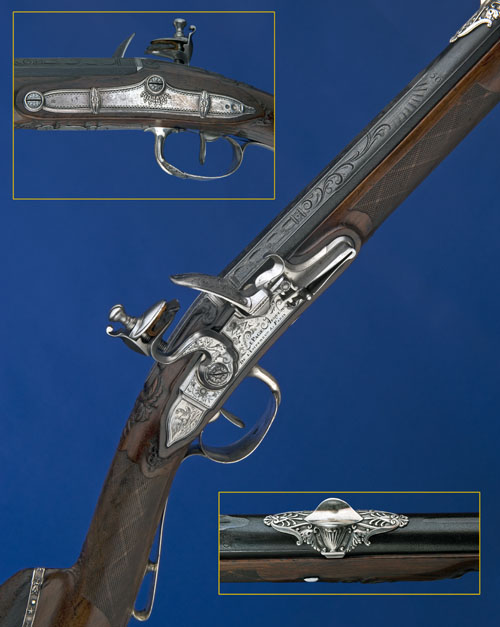
A RARE NAPOLEONIC 20-BORE FLINTLOCK 'FUSIL DES CHASSE IMPERIALES',
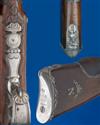
circa 1800, the earlier 38in round, blacked barrel with octagonal breech engraved with swags, martial trophies, reeded columns and a 'Louis XIV' fleur-des-lys, together with the no.'30', fine centre 'rib' forward of a chased and carved rococco style silver rearsight with twin guides, small silver crescentic fore-sight, the flat, banana shaped lock with bevelled edges and stepped tail, inscribed 'LE PAGE ARQUEBUSIER DE L'EMPEREUR A PARIS', together with floral scrolls, lightning-bolts and an eagle to the tail, the neck of the cock (repaired) engraved with a wyvern, lozenge border-line engraved pan, frizzen engraved with lightning-bolts and scrolls, walnut full-stock of swan-necked form, finely skip-chequered at the wrist and forend, carved swags bordering the furniture, silver sideplate of flat form with border engraving and cross-bands, leather silver-banded cheek-piece (slight losses to leather surface), cast and chased silver heel-plate with floral borders, a left facing 'Imperial' eagle to the spur and another (possibly later) engraved to the rear, right hand side of stock inlet with a letter 'N' together with an 'Imperial' crown flanked by swags, cast silver trigger guard engraved with an 'Imperial' eagle (facing left, possibly later), the grip section with the number '30' overstamping an earlier '55', pre 1809 silver marks, 'bombe' style finial, silver ram-rod pipes and fancy chased throat, ebony ram-rod with horn tip and steel wormed end (barrel re-finished with traces of pitting, metal surfaces polished).
Provenance:
Napoleon Bonaparte, later to become Napoleon I of France, was born on the island of Corsica to parents of noble Italian descent on 15th August 1769. By the time of his death fifty one years later, also on an island, he had done more to shape the continent of Europe than perhaps any other man in the last two centuries.
Born the second of eight children, his parent's modest wealth afforded Napoleon an education on the mainland of France, first at a religious school in Autun and then the distinguished École Militaire in Paris which bore him into the French army. It was said that Napoleon was an excellent sailor and, rather ironically, he did consider applying to the British Royal Navy, the most powerful in the world at the time.
Napoleon's rise to power is well documented, its path was not smooth and success was not always assured, indeed, he spent several periods out of favour with both the authorities and the people. However, his coup d'état in 1799 was successful and he appointed himself First Consul. A mere five years later the French Senate declared him Emperor and he was also the ruling monarch in Italy from March of the following year.
The French Revolution sent Europe into turmoil, and war between France and her largely monocratic neighbours was inevitable. Napoleon also intended to invade Great Britain but he was mindful that his navy was too weak to face a battle in the English Channel. Instead he tried to undermine British trade routes to India and establish a French colony in Egypt. He took the tactically important island of Malta before reaching Egypt where his campaign began well despite being vastly outnumbered by native Mamluks. However, he was pursued by Nelson who decimated the French fleet while they lay at anchor; all but two ships-of-the-line were either captured or sunk. Five years later, at Trafalgar, the French were literally to feel the heat from their own guns aboard the captured ships now sailing under the Union Flag.
Trafalgar aside, Napoleon was to enjoy a string of victories involving many European powers. He had a tactically brilliant mind and used his infantry and artillery as a joint force complementing one another, rather than as separate units. His set-piece attacks were well thought-out but he was also able to give decisive orders in the heat of a moving front. The tide only turned on spreading French influence when Napoleon invaded Russia in 1812; his Grande Armée never fully recovered from a series of punishing defeats. The following year coalition forces defeated his men at Leipzig before invading France in 1814 when he was exiled to the island of Elba. It was only a matter of months before he escaped and returned to power. However, the massed armies of Wellington and Blücher, under the former's command finally defeated Napoleon at the Battle of Waterloo in June of 1815.
He was to spend the final six years of his life confined to the British island of St. Helena. His plight attracted a degree of sympathy, even from the British, and his hope for release never waned. At one time there was suggestion of a rescue attempt being mounted by exiled soldiers from him Grande Armée who were living in Texas; they hoped for a resurrection of the Napoleonic Empire in America which had only fallen when France sold her land rights to the United States.
Napoleon was buried in an unmarked grave on St. Helena, but in 1840 his remains were brought back to France and in 1861 were entombed in a sarcophagus in the crypt of Les Invalides in Paris.
Other Notes: Jean Lepage was born 1746 into a highly talented family of French gunmakers. He was to inherit the title of Gunmaker to the King in 1779 from his uncle, Pierre Lepage during the last years before revolution. Like his contemporary, Nicolas-Noel Boutet, Lepage lived through a tumultuous time in French history as she moved from monocracy to republic, followed by a brief resurgence of the French royal family and thence back to a republic.
Before the revolution he built a number of fine sporting and presentation pieces for King Louis XVI and was also gunmaker to another member of the Bourbon dynasty, Louis Philippe Joseph d'Orleans, later known as Philippe Égalité due to his apparent support for the revolution (he was still to suffer the same fate as the King though). Lepage was untouched by the revolution due both to his skill and because he was not of noble birth. He worked both from Paris and the arsenal at the Palace of Versaille and later became maker to Emperor Napoleon Bonaparte and, after his exile, King Louis XVIII.
Lepage was not only a fine maker; he was also possessed of an inventive mind. During the first decade of the 19th Century, he invented a new form of ignition that was further developed by his peers to become the percussion cap. The flintlock had been honed into a relatively fast and reliable form of ignition, but the method of enclosing the fulminates made for an even more dependable system that rendered flintlocks obsolete for the most part within three decades.
Lepage retired from his post in 1822 and died, aged 87, in 1834.
Visiting dignitaries, invited to hunt by royal invitation, rarely brought their own firearms, instead using fine quality pieces loaned to them by Napoleon. The vendor kindly informs us that this was one of a number of such pieces held in Napoleon's armoury
Estimate £50,000-60,000
THE ABOVE LOT IS PURCHASED AS AN EXEMPT ITEM UNDER SECTION 58 (2) OF THE 1968 FIREARMS ACT. TO BE HELD AS A CURIOSITY OR ORNAMENT.