

Product Details
J. PURDEY, LONDON
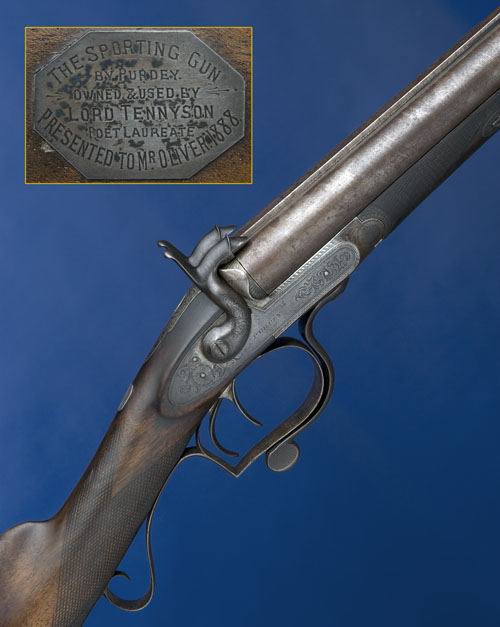
A 12-BORE PINFIRE ROTARY-UNDERLEVER DOUBLE BARRELLED SHOTGUN, no visible number,
converted from muzzle loading (by another), with 28in. browned barrels, the rib signed 'J. PURDEY, 314 1/2 OXFORD ST, LONDON', bar action scroll engraved locks signed 'PURDEY', border engraved action, percussion fences, figured walnut chequered stock and fore-end, silver vacant escutcheon at wrist and a second to the left hand side of stock inscribed 'THE SPORTING GUN BY PURDEY OWNED & USED BY LORD TENNYSON POET LAUREATE PRESENTED TO MR OLIVER 1888', iron long-spurred heel-plate and scroll-shaped square back triggerguard with scroll engraving, rotary underlever with further scrolls, border engraved fore-end cross bolt escutcheons and horn inlet fore-end tip
Provenance:
Alfred Tennyson, 1st Baron Tennyson, F.R.S. was born into a Lincolnshire family on 6th August 1809. He was the fourth of twelve children with a family lineage that can, reportedly, be traced back through his paternal grandfather, to Edward III.
Tennyson's father was a moderately wealthy rector but did not send his son away to school. Instead, the young Alfred attended Grammar schools in nearby Louth before going up to Trinity College, Cambridge in 1827. It was here that he was to meet his closest friend, Arthur Henry Hallam, who would later become the subject of the poem that sealed Tennyson's ability as a first-rate poet.
However, Tennyson's early works did not arouse the interest he had hoped for in some quarters, although one of his first pieces, 'Timbuctoo' was responsible for his being awarded the Chancellor's Gold Medal at Cambridge. Some critics labelled his first published collection of poems, 'Poems Chiefly Lyrical' (1830) as too sentimental, but they proved popular nevertheless, and brought him to the attention of other talented writers of the day such as Coleridge. Tennyson's father died in 1831 and the subsequent withdrawal of funding meant that Alfred had to leave Cambridge before finishing his degree. He returned to look after his mother and family and they were able to live at the rectory for a further five years. Hallam, who spent time with the family during holidays, struck up a relationship with Tennyson's sister, Emilia, and they were later to become engaged.
Ironically, it was the premature death of his close friend that inspired Tennyson to some of his most acclaimed works. Hallam died of a brain haemorrhage in 1933 and his death had a profound impact on Alfred's thinking, moving him to write the ode 'In Memoriam A.H.H.'. However, it was not until 1850 that he published the piece that was widely considered to represent his finest work.
He acceded to the post of Poet Laureate in the same year following the death of William Wordsworth. Tennyson was to hold the position until his own death in 1892, the longest tenure of any laureate by some margin. Amongst his works during his early years with the post was 'The Charge of the Light Brigade'; the well-known ode to the ill-fated British cavalrymen who charged on heavily defended Russian positions during the Crimean War.
Queen Victoria, a great admirer of Tennyson's work, created him a Baronet in 1883, although it is said that he was uncomfortable with the title, though appreciative of the thought behind it. He thence became Baron Tennyson of Aldworth in the County of Sussex and of Freshwater in the Isle of Wight.
Alfred, Lord Tennyson died aged 83, on 6th October 1892 and was buried at Westminster Abbey. The title passed to his son Hallam, named after his close friend, who was later to write a biography on his father.
Estimate £1,500-2,000
THE ABOVE LOT IS PURCHASED AS AN EXEMPT ITEM UNDER SECTION 58 (2) OF THE 1968 FIREARMS ACT. TO BE HELD AS A CURIOSITY OR ORNAMENT.