

Product Details
FORMERLY THE PROPERTY OF THE LATE AIR COMMODORE E.W. 'BERTIE' WOOTTEN, C.B.E., D.F.C. and Bar, A.F.C., F.B.I.M.
WILLIAM EVANS
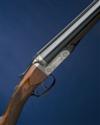
A 12-BORE (CENTRAL VISION) BOXLOCK EJECTOR, serial no. 4265,
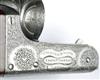
28in. nitro reproved barrels, the rib engraved 'WILLIAM EVANS FROM PURDEYS, 63 PALL MALL, ST. JAMES'S, LONDON' (indistinct), wall-thicknesses below recommended minimum, 2 1/2in. chambers, bored approx. 1/4 and 3/4 choke, treble-grip action with removable striker discs, intercepting sears, automatic safety with gold-inlaid 'SAFE' detail, carved stylised leaf fences, bouquet and tight acanthus scroll engraving, the makers name engraved within a decorated cartouche, brushed bright and reblued finish, 15 3/4in. replacement stock cast for central vision, bolstered fore-end, weight 6lb. 2oz., in a brass-cornered leather guncase
Provenance: This shotgun was the property of the late Air Commodore E.W. 'Bertie' Wootten C.B.E., D.F.C. and Bar, A.F.C., F.B.I.M., and is being offered at auction by his widow.
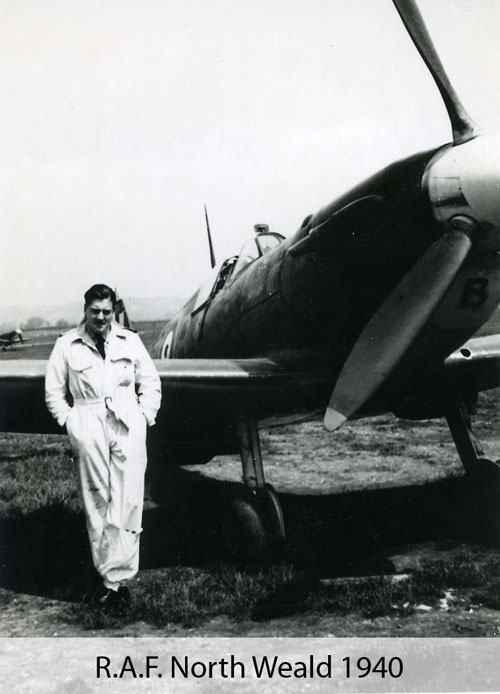
Wootten was born November 1918 in Monmouthshire just days before the end of the Great War. The family moved soon after to Worcester and it was because of this that he gained the sobriquet Bertie. He was to enjoy a long and highly distinguished career with the Royal Air Force which began with the outbreak of hostilities just 19 years later. It was then that he was granted a Short Service Commission as Acting Pilot Officer and spent his time during the 'phoney war' at Observer School and acting as a ferry pilot for Hawker Hurricanes going to and returning from France. The period of relative calm came to an abrupt end with Germany over-running the Low Countries closely followed by the capitulation of France. Hitler now turned his attention to Great Britain and the stage was set for what became known as The Battle of Britain.
Wootten was posted to 234 Squadron flying Supermarine Spitfires from Warmwell, a satellite airfield of Middle Wallop. He was one of the seemingly tireless, though in truth, exhausted young men who flew several sorties each day against a numerically superior foe. Due to their position, 234 spent much time defending the Royal Naval base at Portland where Wootten demonstrated his ability as a superb marksman. In August of 1941 he was made up to Flight Commander of the squadron and awarded the D.F.C. the citation for which read, "This officer has displayed great dash, enthusiasm and flying ability throughout all the operations in which he has participated. He has destroyed at least five enemy aircraft, of which two were shot down in one engagement."
After being rested for a period, Wootten returned to operations in June 1942 as C.O. of 118 Squadron based at Ibsley. It was during this period that he was chosen to fly several aerobatic sequences for the propaganda film "The First of the Few" starring David Niven. The film chronicled the development of the Spitfire and the declining health of her genius designer Reginald Mitchell. After rolling out of a loop into a low-level pass Bertie was asked by the director if he couldn't do something a little more dramatic. This was all the encouragement he needed and his ensuing display saw some highly entertaining film being lost, along with the camera, as both director and cameraman had to jump into the bushes to avoid a Spitfire travelling at 300 knots just above ground level!
After several postings, including command of the Coltishall Wing, Bertie was sent to Italy to assist the invasion forces after the landings. During one sortie his aircraft was hit and lost its engine. He managed to make a forced short-field landing just behind British lines. He over-shot the field, ploughed through a hedge and just passed between two lorries of a convoy. One of the drivers is alleged to have exclaimed, "Bloody road hog, next time you're going to do that sound your bloody horn!"
Wootten ended the war with a Bar to his D.F.C. and 13 1/2 confirmed kills. He was asked to remain with the air force and was granted a permanent commission in 1948. He saw service overseas for a time before returning to command 245 Squadron who were flying Gloster Meteors from Horsham St. Faith in Norfolk where he formed and led the R.A.F.'s first aerobatic team with jet aircraft. It was during his time with 245 that he was awarded the A.F.C.
He rose steadily through the ranks and in 1959 was appointed Air Attache to Venezuela before returning to Britain as S.A.S.O. 11 Group in the 1960s, a difficult time for the air force as it was repeatedly undermined financially by short-sighted government thinking. During the flight home to Great Britain from Venezuela in 1961, Bertie was pilot-in-command of De Havilland Devon VP964 (a military variant of the civil Dove) with three passengers aboard including his wife. He was forced to land on water due to poor weather during the later stages of the journey between Goose Bay, Canada and Bluie West One in Greenland. Although the aircraft was lost, his skill saved the lives of the occupants.
Bertie retired holding the rank of Air Commodore in 1973. He was a popular and highly respected officer with a great sense of mischief, though with a caustic tongue reserved for those showing incompetance. He was a great exponent of Group Captain Harry Day's (often wrongly attributed to Douglas Bader) delightfully laconic expression 'rules are made for the obedience of fools and the guidance of wise men'.
Estimate £300-500
S2