

Product Details
FORMERLY THE PROPERTY OF LADY ANN HAMILTON
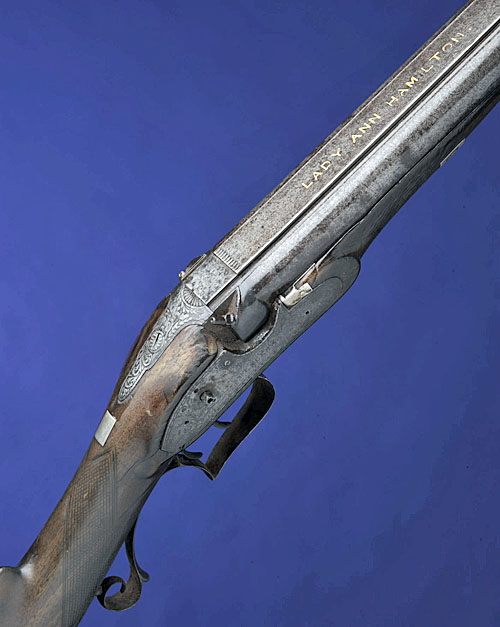
AN 8-BORE DOUBLE-BARRELLED PERCUSSION SHOT AND BALL GUN SIGNED SPENCER,
circa 1800, converted from flint circa 1840, with 27 1/2in. barrels, wide, flat , top-rib with bead foresight, signed in gold block letters 'LADY ANN HAMILTON' (sic), flat, fancy border engraved locks signed 'SPENCER', scroll engraved and bordered hammers (detached but present), chequered walnut half-stock with 1 1/4in extension and inlets around the heel-plate spur and behind the locks, square-backed scrolled tang trigger guard, white-metal wedge escutcheons and fancy ramrod throat, possibly original ramrod, the whole in distressed condition with numerous old repairs and cracks to stock, iron surfaces stained with a few patches of deep corrosion and losses throughout
Provenance: Lady Anne Hamilton was born March 1766, eldest daughter to Archibald, the 9th Duke of Hamilton. Her family had an established political background and the second son, and his father's namesake, was a well-known political reformer.
She entered the royal court as Lady-in-Waiting to Caroline, Princess of Wales and the two were to become close friends. The Princess was a colourful figure loved and reviled in equal measure due to her rather lascivious nature. Her marriage to the Prince of Wales and son of King George III appears to have been one of convenience and the future King was not particularly interested in his wife. Lady Hamilton remained as her senior aide until the Princess left on her own for Europe in 1813 after it was suggested she had committed adultery with a footman and borne him a son.
She returned to England in 1820, Lady Hamilton meeting her at Montbard and the two of them took up residence in Portman Square. The 'delicate investigation' of her for adulterous behaviour was abandoned and her Lady-in-Waiting accompanied her to St. Paul's on 30th November to give thanks for her acquittal. King George III had died in January of that year and so Caroline had become The Queen regardless of the fact her marriage to George IV had broken down. At the coronation service of the new King at Westminster Abbey, The Queen demanded to be allowed into the building to take her place in the ceremony but her way was barred at the entrance by the several pages who were under strict orders not to allow her entrance. This clearly had a profound effect on her and she died 19 days later.
Lady Hamilton's later life was spent in financial straits; in spite of her long service to Queen Caroline she had only been left a portrait of her as a memento. She had been left a legacy of £10,000 on the death of William, 4th Duke of Queensbury in 1810 but had elected to pass this to her brother Archibald. So it was that she gave her confidence in later years to someone who, without her knowledge, wrote and published a book entitled 'Secret History of the Court of England from the Accession of George III to the Death of George IV'. The publication in 1832 caused her much angst.
Lady Hamilton was resident in Islington when she died on 10th October 1846 and was buried at Kensal Green cemetery.
Other Notes: A sheath of papers regarding the provenance, together with several photographs accompany this lot.
Estimate £800-1,200