

Product Details
J. PURDEY & SONS
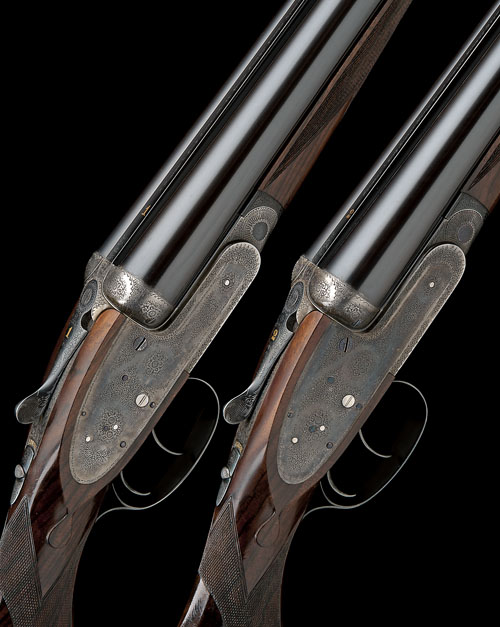
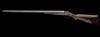
A FINE PAIR OF 12-BORE SELF-OPENING SIDELOCK EJECTORS, serial no. 25235 / 6,
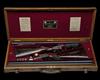
30in. nitro chopperlump barrels, ribs engraved 'J. PURDEY & SONS. AUDLEY HOUSE. SOUTH AUDLEY STREET. LONDON. ENGLAND.', and gold-inlaid '1' and '2', No.1 right wall at 18, 2 1/2in. chambers, bored approx. 1/4 and 3/4 choke, self-opening actions with removable striker discs, toplevers gold-inlaid '1' and '2', automatic safeties with gold-inlaid 'SAFE' details, cocking-indicators, best fine bouquet and scroll engraving, retaining much original colour-hardening and finish, 15 1/4in. highly-figured pistolgrip stocks, horn pistolgrip-caps, weight 6lb. 11oz., in their brass-cornered oak and leather case with some accessories
Provenance: We are kindly informed by the makers that this pair of shotguns were completed April 1937 with 30in. barrels for Whitney Straight.
Air Commodore Whitney Willard Straight, C.B.E., M.C., D.F.C. was a colourful and lively figure whose exploits could have inspired any number of 'Boy's Own' annuals.
He was born to American parents, Major Willard Straight and the heiress Dorothy Payne Whitney, in November 1912 and lived in the United States until 1925. His father succumbed to influenza during the great pandemic of 1918 while serving in France with the U.S. Army (the outbreak killed 3% of the World population). His mother later met and married the noted English agronomist Leonard Elmhirst, and the family moved across the Atlantic to Dartington Hall. The young Straight attended the progressive school set up by his parents at the hall (also known as the Dartington Experiment) before going up to Cambridge.
Straight developed a passion for motor cars while still an undergraduate at Trinity, and he became a noted Grand Prix driver (he was to compete in more Grand Prix than any other American prior to the last war. His career proper began in 1931 when he campaigned a Brooklands Riley competing at many meetings including several at the famous Surrey circuit of the same name. In 1933, driving a Masarati, he won the Brooklands Mountain Championships, the Mont Ventoux Hill Climb and the Brighton Speed Trials. He also won the 1,100c.c. class of the Coppa Acerbo at Pescara driving an M.G.
The following year he formed his own team and drove to first place in the South African Grand Prix held on the long 16-mile circuit at East London. He was also to give many public demonstrations of motoring trickery at Brooklands, and held the record, for a time, for the 5-litre class of 138.7 m.p.h.
Flying was also a great love of his, and he already had sixty hours solo on his logbook by the time he was sixteen, officially still too young to hold a pilot's licence. He made aviation his career and by the late 1930s operated a number of airfields in Great Britain, as well as owning Western Airways Ltd. By this time he had become a naturalised British subject and had married Lady Daphne Margarita Finch-Hatton, daughter of the 4th Earl Winchilsea and niece of the famous Denys Finch-Hatton (whose life was brought to the screen in the film 'Out of Africa').
When hostilities broke out in 1939 it was natural for Straight to join the Royal Air Force, and he served his adopted country with a good helping of courage and élan. Initially posted to 263 Squadron, he was tasked with finding a frozen lake in Norway that was suitable for use as an airfield to facilitate the planned invasion (he was later awarded the Military Cross for his efforts). Lake Lesjaskog was chosen but Straight was badly wounded during a German bombing raid. After a period spent convalescing he was posted to 601 (City of London) Squadron flying Hawker Hurricanes. It was common practice for squadrons to move frequently to a different airfield, and in the period that Straight flew with them they operated from Tangmere, Exeter and Northolt (their home and where the squadron was formed in 1926). He was credited with two confirmed kills during this period.
He was then posted to 242 Squadron as C.O. (Douglas Bader was one of his predecessors in that role) and by the end of July 1941 his tally had risen to 3 confirmed with 1 shared and 2 'probables'. On the last day of July, however, he was shot down by flak over France but managed to bail out. He initially evaded capture and was handed along an escape route towards Spain by the French Resistance. Whilst in un-occupied Vichy France though he was discovered and put into a P.O.W. camp. The camp couldn't counter his escape efforts and he had only been interned there a short time when he broke out, and with the continuing aid of the Resistance made his way to Gibraltar and freedom.
In the September of 1942, and now as an Air Commodore, he was sent to the Middle East as A.O.C. 216 Group, a post he was to hold until war's end. He then returned to Britain and served, briefly, as A.O.C. 46 Group before being released from the service late 1945. The same year he was appointed Chairman of the Royal Aero Club.
He returned to peacetime aviation and by 1949 had been made Deputy Chairman of the board of B.O.A.C. (British Overseas Airways Corporation) after serving as both managing director and chief executive. Interestingly, at the same period but on the other side of the Atlantic, his cousin, Cornelius Whitney, had become President of the airline that was to become Pan American Airways.
Straight later joined the aero division of Rolls-Royce as Deputy Chairman. He was part of a delegation to Peking in 1958 and was aghast to discover that the Russian MiG aircraft were powered by Soviet versions of the Nene jet engines. These had clearly been copied from a consignment sent to Russia under an export licence granted by the socialist government of Clement Attlee. Straight was predictably unsuccessful in his attempt to claim back over £200m from the Soviets in un-paid royalties.
Whitney Straight died in 1979 when still only in his mid-sixties; a relatively short life, but certainly a full one.
Estimate £30,000-35,000
S2