
Product Details
J. PURDEY & SONS
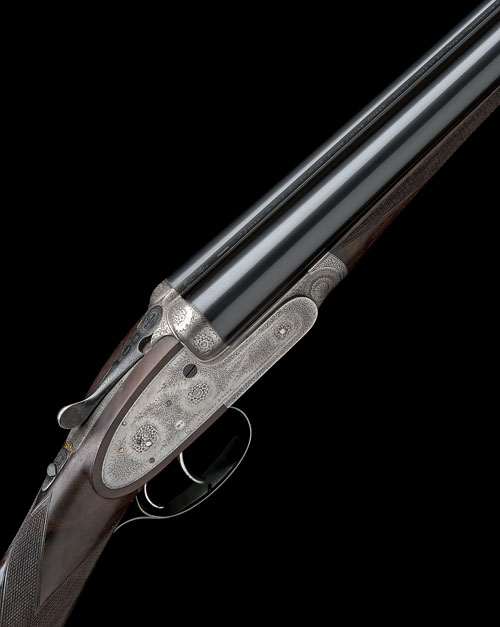
A 16-BORE SELF-OPENING SIDELOCK EJECTOR, serial no. 19065,
29in. nitro reproved chopperlump barrels (in 2012), rib engraved '1' and 'J. PURDEY & SONS. AUDLEY HOUSE, SOUTH AUDLEY STREET, LONDON. MADE OF SIR JOSEPH WHITWORTH'S FLUID-PRESSED STEEL.', 2 1/2in. chambers, bored approx. true cyl. and 1/4 choke, self-opening action with removable striker discs, toplever engraved '1', automatic safety with gold-inlaid 'SAFE' detail, arrow cocking-indicators, articulated front trigger, best fine bouquet and scroll engraving, brushed and blued finish overall, 13 3/4in. well-figured replacement stock with diamond grip and including 3/8in. horn buttplate, weight 6lb. 5oz., in a brass-cornered leather case
Provenance: The makers have kindly informed us that this shotgun was completed as no.1 of a pair with 29in. barrels for Baron L. de Rothschild.
Lionel Walter Rothschild, 2nd Baron Rothschild, F.R.S. (also styled as Baron de Rothschild) was the eldest son of Lord (Nathan) Rothschild, Britain's first Jewish peer to be raised to the House of Lords.
He was born 8th February 1868 and moved to the family home at Tring Park when he was four. The family viewed him as delicate in health and so he was schooled at home before spending a year at Bonn University and then going up to Magdalene College. He left Cambridge after two years and entered the family's enormously successful banking business, although it seems with some reluctance and dis-interest.
Rothschild's true love and consuming interest was zoology and this stemmed from an early age. Indeed, when aged just seven he stated that he would one day found a zoological museum, a declaration that was to come to fruition. At its height, his museum housed more specimens than any other private collection in the world. His travels were restricted mainly to Europe and North Africa and largely because of health concerns, but he employed a great number of naturalists in other parts of the globe to collect and send back specimens for him. He described a good number of hitherto unknown sub-species that now carry his name. The largest of these is the Rothschild giraffe but the other end of the size scale is also represented in the form of three spiders, a millipede and a worm.
He was allowed to leave the family bank in 1908 although it appears that this was not without friction. His father had never entirely approved of his son's passion for the study of animals and this came to a climax when, after a particularly serious disagreement, the 1st Baron dis-inherited him. This was a grave step but did not, as it might have done, ruin Walter's social standing. He was given a capital sum of £1,000,000, a fantastical amount of money by the standards of the day, and he was able to mount further expeditions to find yet more additions to his museum.
The grounds of Tring Park became home to all manner of beasts, from the expected deer through to various types of kangaroo. These caused awful problems for the gardeners as they'd hop over the ha-ha into the formal gardens and merrily eat the flowers and generally make a mess. The staff had to swiftly clear up any damage and re-plant before Lord Rothschild appeared at the stables each morning for his 06.30 hack.
Walter Rothschild, whilst reportedly shy, did court public exposure on occasion. This is most notably illustrated by his determination to show that zebra could be broken and used as teams for carriage driving. He demonstrated this by driving a team of six up to Buckingham Palace, apparently without mis-hap.
He also had political interests and acted as the Member of Parliament for Aylesbury (Liberal) from 1988 until the 1910 general election when he retired. Rothschild never married and lived with his mother until her death in January 1935. Under the terms of his father's will, he then had to quit Tring Park as it was left to his brother. Just two years later Lionel Walter Rothschild died and the following year his brother, now 3rd Baron Rothschild, offered the contents of the museum to the nation and it now forms part of the collection at the Natural History Museum.
Estimate £4,000-6,000
S2