

Product Details
AN INTERESTING GROUP OF EPHEMERA RELATING TO VIDKUN QUISLING,
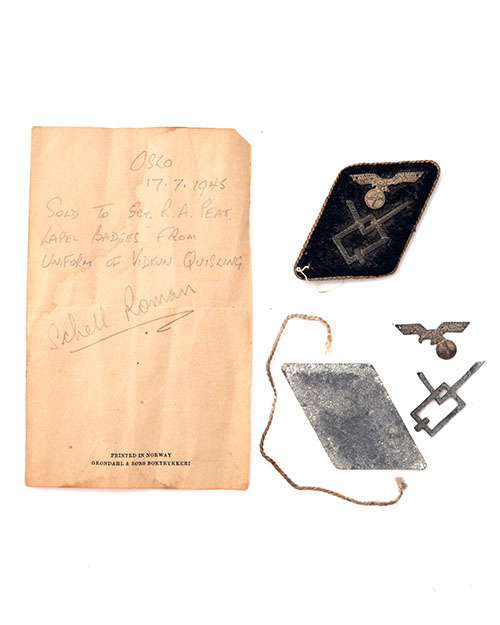
comprising of a black felt collar-dog with silver braid border, the face mounted with an alloy stylised 'VQ' monogram and surmounted with a separate eagle device clutching a Norwegian cross within a circle, together with another incomplete derelict collar dog of the same type and a hand written note dated Oslo 17-7-1945 reading 'SOLD TO SGT R.A. PEAT. LAPEL BADGES FROM UNIFORM OF VIDKUN QUISLING' and signed 'Schell Roman'
Provenance: The vendor states that his father, Ronald Peat, purchased these items from an enterprising Norwegian at the end of World War Two. Unfortunately there is no proof that these actually were the property of Viskun Quisling himself, and indeed this is very unlikely, but Norwegian 'VQ' collar-dogs are extremely rare and seldom encountered today, being only worn by members of the Norwegian Nasjonal Samling Forergarde, collaborators with the German Nazi party.
Other Notes: Vidkun Quisling was born 18th July 1887, the son of a Norwegian pastor. Considered by many to be an able man, he amalgamated the fundamentals of Christianity, philosophy and scientific development into a new theory he called Univercism. Before entering the world of politics, he had already proved his military worth; having joined the General Staff in 1911 specialising in Russian affairs. He was posted to Russia in 1918 and was to oversee much relief work during the Ukrainian famine of 1921. When his colleague (and later political sponsor), Frederik Prytz returned to Norway in 1927, Quisling stayed as Norwegian diplomat responsible to the management of British diplomatic affairs. King George V conferred on him the C.B.E. for his services, although the honour was later rescinded.
Quisling's political aspirations followed a rather tortuous route with many changes of policy and allegiances, and he was never to hold the consensus of support in Norway, even at the height of his 'popularity'. His views had always tended towards the far-right and he had met Adolf Hitler and other senior Nazi party officials several times during the 1930s. He eventually seized power soon after the German invasion of Norway, which began on 9th April 1940, with a Nazi-backed coup d'etat. German support for Quisling ebbed and flowed during the war, but certainly he had lost the full backing of Hitler once the level of public confidence in him was known. It is thought that Quisling wanted a Norway ruled by the Norwegians; he certainly wasn't in favour of the country being annexed and falling under German rule. However, he was forced to serve under Hitler's appointed Reichskommissar, Josef Terboven, although he was later appointed Minister President in February 1942.
The Quisling regime enjoyed varying levels of support from Germany, but was never recognised by the Norwegian government in exile, or King Haakon. Quisling had genuinely hoped to secure the backing of his King, and was surprised when it wasn't forthcoming. He was equally disappointed that Norwegians, in general, were not in support of him. After a period of public coercion, he eventually took the tack that the people would do his will whether they wished to or not. At the same time though, he successfully argued for the promise of a fully independent Norway after the (hoped for) victory by the Axis powers. Quisling was considered a traitor to his country by the majority of Norwegians, and his name became synonymous with treasonable acts. He spent the final months of the war trying to minimise Norwegian casualties during the increasing activity between German and allied forces. He did order that the police should offer no resistance to allied forces and later made the naïve offer of a power-sharing agreement with the exiled true government. However, these acts only came to pass once it was obvious to him that Germany was about to be defeated.
Quisling prepared for his arrest and pleaded that he had acted with the best interests of his country at heart. His entreaties were to no avail and he was found guilty and sentenced to death by the court. This was carried out by firing squad on 24th October 1945.
Please refer to terms and conditions for commission and shipping information. Please click HERE to view Terms & Conditions.
Estimate £200-300