

Product Details
J. PURDEY
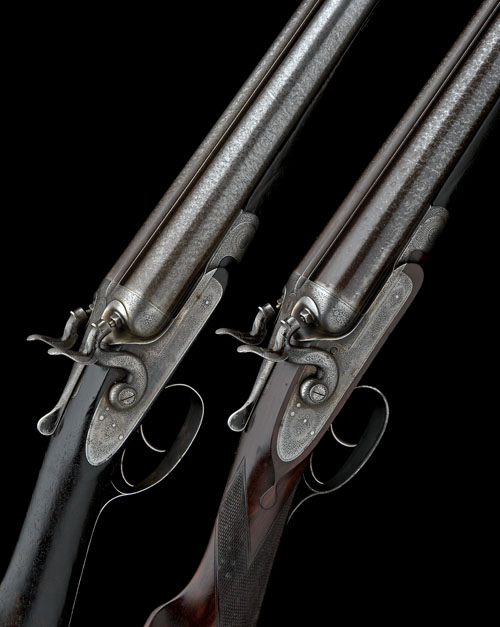
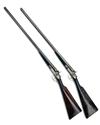
A PAIR OF 12-BORE BAR-IN-WOOD TOPLEVER HAMMERGUNS, serial no. 9899 / 9900,
30in. black powder only fine damascus barrels, ribs engraved '1' and '2' and 'J. PURDEY 314 1/2 OXFORD STREET. LONDON', 2 1/2in. chambers, bored approx. 1/4 choke in all, some pits, dents and bulges both (No.2 more significant), carved percussion fences, rebounding sidelocks with dolphin hammers, best fine bouquet and acanthus scroll engraving, retaining traces of original colour-hardening and finish, No.1 with rolled-edge triggerguard (likely replacement), 14 1/2in. figured stocks (No.1 a replacement, No.2 cracked at hand), weight 6lb. 12oz. (No.1) and 6lb. 15oz. (No.2)
Provenance: The makers have kindly informed us that this pair of shotguns were completed 1877 with 30in. barrels for Lord Balfour of Burleigh, the current Lord Balfour's grandfather.
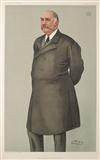
The 6th Lord Balfour, K.T., G.C.M.G., G.C.V.O., P.C., D.L., J.P., was born on 13 January 1849, into the Scottish family whose then seat was at Kennet, Clackmannanshire. Educated at Loretto, Eton and Oriel College, Oxford, he was subsequently a successful politician, banker and industrialist. Alexander Hugh Bruce was the only son of Robert Bruce of Kennet, the peerage of 1607 having been attainted in 1715, the 5th Lord Balfour of Burleigh having supported the losing side in 1715. (As James Balfour, he had earlier been sentenced to death for the murder of a local schoolmaster, had escaped from prison after exchanging clothes with his sister, and fled to France, returning in 1715 as a supporter of Bonnie Prince Charlie.) In 1864 the attainder was reversed by Act of Parliament, and in 1868 Alexander Hugh Bruce acceded to the title. As 6th Lord Balfour of Burleigh, he was elected in 1876 as a Scottish Representative Peer, sitting in the House of Lords. A Scottish Unionist, he became Education Commissioner for Scotland and in 1887 a Lord-in-Waiting in Lord Salisbury's administration. He was Parliamentary Secretary at the Board of Trade from 1888 to 1892, when the Liberals returned to power. In 1895 he became Secretary for Scotland [the office that is now Secretary of State for Scotland], but resigned eight years later when the Conservative and Unionist Party split over Free Trade. Following his withdrawal from parliamentary politics, Lord Balfour of Burleigh was an active business man, as Governor of the Bank of Scotland from 1904 to 1921, a founder director of the Eastern Telegraph Company, and other associations. Active in the Church of Scotland, he was Queen Victoria's trusted adviser, mediating in local church disputes. He chaired many Commissions and public enquiries, including, crucially, the dispute that threatened to halt the production of munitions on the Clyde in the winter of 1915.
Lord Balfour married Lady Katharine Eliza Gordon, youngest daughter of the 5th Earl of Aberdeen. Of their two sons and three daughters, the elder son, Robert Bruce, Master of Burleigh, was killed in action during the Great War. The younger son, George John Gordon Bruce, thus succeeded to the title, as 7th Lord Balfour of Burleigh, on the death of his father on 6 July 1921. The 7th Lord Balfour, user of a number of the guns listed here, was himself a much decorated soldier of the First World War, directing a daring espionage operation behind enemy lines in 1917-18. His later career, like that of his grandfather, was in business - he was chairman of Lloyds Bank from 1946 to 1954 - and public life, as chairman of the Medical Research Council 1946-48, and of other commissions and institutions. The current Lord Balfour of Burleigh succeeded his father on the 7th Lord Balfour of Burleigh's death on 4 June 1967.
Other Notes: These guns have remained with the family since completion and are being offered at auction by the current Lord Balfour of Burleigh.
For associated provenance please see Lot 1238.
Estimate £3,000-5,000
S2