

Product Details
PARKER BROS.
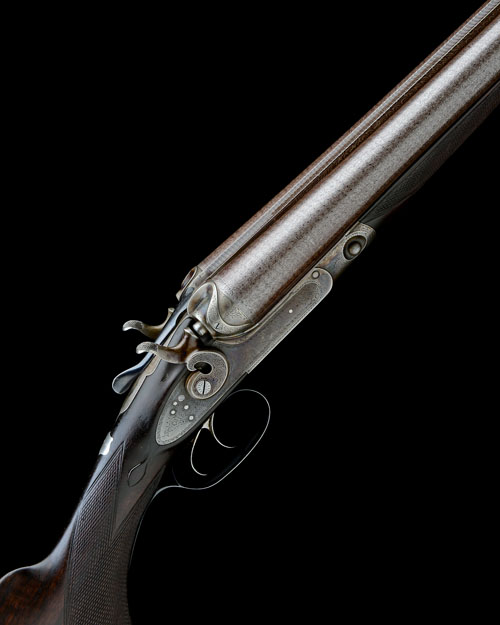
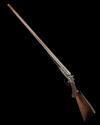
A 10-BORE (89MM) 'QUALITY 3' 1875 PATENT DOUBLE-BARRELLED TOPLEVER HAMMERGUN, serial no. 53759,
32in. nitro reproved fine Belgian damascus barrels, broad matt rib engraved 'PARKER BROS. MAKERS. MERIDEN. CONN. DAMASCUS STEEL.', 89mm chambers, bored approx. 1/2 and full choke, Parker patent action with offset hold-open toplever, deep carved serpentine percussion fences, broad strikers, rebounding sidelocks with carved c-scroll hammers, fine scroll engraving surrounding game scenes of pointer, the underside with a vignette depicting a covey of partridge, action flats engraved 'PATD. apr. 11 1876, p. 31872, PATD. MAR 16. 1875', the triggerguard tang engraved in script 'PAT D. MAR 23 1875', retaining traces of colour-hardening and reblued finish, 14 1/4in. well-figured pistolgrip stock with pistolgrip-cap and blued skeletal buttplate, fore-end with Deeley & Edge patent release catch, weight 9lb. 15oz.
Provenance: This Lot is accompanied by a sheath of papers collated by the vendor and includes a copy of a letter from Parker, part of which states:
"Parker shotgun, serial number 53759, was ordered by F.H. Wells in Burlington, VT on October 1, 1889. According to Parker Bros. Order Book No.26 it was a quality 3 Top Action hammer, 10-gauge. It featured damascus steel barrels with a length of 32inches."
Not a great deal has been written about Wells, but we know that he joined a successful family business involved with the manufacture and wholesale of medicinal drugs. This had been set-up in Burlington by Edward Wells, A.E. Richardon and W.J. Van Patten in 1872. The company was highly successful and best-known at the time for the introduction of Kidney-Wort into the medical world.
Well's Father was rather better known; he was William Wells, Jr., a politician and general in the Unionist army during the American Civil War. He was born December 1837 in Waterbury, Vermont, the third of ten children.
At the outbreak of the Civil War, Wells (as a private soldier), together with three of his brothers, enlisted with the Union army in September 1861, and assisted in raising Company C of of the 1st Vermont Cavalry. He was sworn into federal service the following month and by November had already been promoted to captain. By the October of the following year, following fierce action at Orange Court House, Virginia, he was promoted to major. His advance continued apace due to his steadfast leadership and gallantry, and he was awarded a Medal of Honour "for distinguished gallantry at the Battle of Gettysburg" by Congress in July 1863, when, in spite of carry a deep sabre wound, he charged the enemy's line at Culpepper Court House with his regiment and captured an piece of heavy ordnance.
On 16th May 1895, Wells was advanced to brigadier-general on the express recommendations of Generals Custer and Sheridan, and was soon after appointed brevet major-general of volunteers for "gallant and meritorious service". He received a greater number of promotions than any other Vermont office. General Sheridan remarked that "he is my ideal of a cavalry officer".
He was honourably mustered out of the army in January 1866 and then became a partner in the family's business at Waterbury.
Please click HERE to view Terms & Conditions.
Estimate £2,500-3,500
S2