

Product Details
FORMERLY THE PROPERTY OF SAMUEL F. CODY
B.S.A. Co
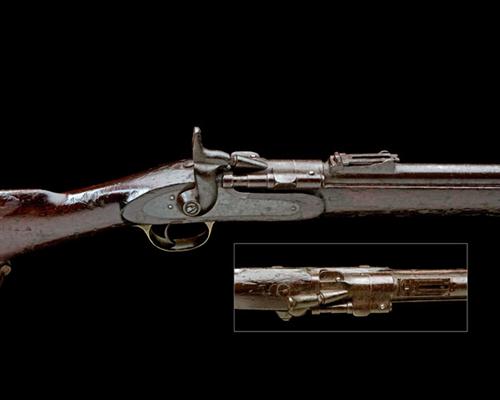
A .577 (SNIDER), SINGLE-SHOT RIFLE, MODEL 'TWO-BAND', serial no. 5,
dated for 1869, with round 30 1/2in. blued barrel, block and blade fore-sight, elevating ladder rear-sight, flip-open breech with spring-loaded thumb-catch, plain bar-action lock signed 'B.S.A. Co' (British South African Company), and the date, walnut three-quarter stock, the right hand side of the butt crudely dot-punched with the initials 'S.F.' and 'CODY' (toe amateurly re-attached) brass heel-plate and trigger-guard, the fore-end with two iron barrel-bands, brass nose-cap and provision for clearing rod (missing), the whole with staining and light surface corrosion
Provenance: See Sothebys 24 Jan 1996, Lot 74
Samuel Franklin Cowdery (later known as Samuel Franklin Cody) was born 6th March 1867 in Davenport, Iowa, USA and died 7th August 1913 in England whilst testing an aircraft of his own design. Cody was a Wild West showman and an early pioneer of manned flight. He is most famous for his work on the large kites known as Cody War-Kites that were used by the British in World War I as a smaller alternative to balloons for artillery spotting. He was also the first man to conduct a powered flight in Britain.
Other Notes: A flamboyant showman, he was and still is often confused with Buffalo Bill Cody, whose surname he took when still young. Cody's early life is difficult to separate from his own stories told later, but he initially attended school until the age of 12. Not much is known about his life at this time although he claimed that during his youth he had lived the typical life of a cowboy learning how to ride and train horses, shoot guns and use a lasso. He later claimed to have prospected for gold in an area which later became Dawson City, centre of the famous Klondike Gold Rush. In 1888, at 21 years of age, Cody started touring the US with Forepaugh's Circus, which at the time had a large Wild West show component. He married Maud Maria Lee in Norristown, Pennsylvania, and the name Samuel Franklin Cody appears on the April 1889 marriage certificate. Later, Cody, together with his new wife, toured England with a shooting act where Maud used the stage name Lillian Cody, which she kept for the rest of her performing career. In London they met a Mrs Elizabeth Mary King, the wife of Edward John King, a licensed victualler, and mother of four children. Mary had stage ambitions for two of her children, Leon and Vivian and in 1891, Maud Maria Lee taught these boys how to shoot; but then later returned to the USA alone. Evidence suggests that by the autumn of 1891, Maud was unable to perform with her husband because of injury, possible mental illness caused by morphine addiction. After Maud returned to America, Edward John King died and Cody took up more than just a professional relationship with Mrs King. While in England, the two lived together as husband and wife, and Mrs King, who soon adopted the name Lela Marie Cody, was generally assumed to be his legal wife. However, the marriage of Cody and Lee had never and was never legally dissolved. Still in England, Cody, Lela and her sons toured the music halls, which were very popular at the time, giving demonstrations of horse riding, shooting and lassoing skills. While touring Europe in the mid-1890s, Cody capitalized on the bicycle craze by staging a series of horse verses bicycle races against famous cyclists. Cycling organizations quickly frowned on this practice, which invariably drew accusations of fixed results, but by 1898 Cody's stage show, 'The Klondyke Nugget', had become very successful; it included Edward Le Roy (Edward King), Lela's eldest son and brother to Leon and Vivian, who were also known as Cody by this time to save any embarrassment. It is not clear why Cody became fascinated by kite flying. Cody liked to recount a tale that he first became inspired by a Chinese cook; who, apparently, taught him to fly kites, whilst travelling along the old cattle trail. However, it is more likely that Cody's interest in kites was kindled by his friendship with Auguste Gaudron, a balloonist Cody met while performing at Alexandra Palace. Cody showed an early interest in the creation of kites capable of flying to high altitudes and of carrying a man. Leon also became interested, and the two of them competed to make the largest kites capable of flying at ever-increasing heights, later Vivian too became involved. Financed by his shows, Cody significantly developed Lawrence Hargrave's double-cell box kite to increase its lifting power, especially by adding wings on either side. He also developed a sophisticated system of flying multiple kites up a single line, which was capable of ascending to many thousands of feet or of carrying several men in a gondola. He patented his design in 1901 and it became known as the Cody kite.
Balloons were then in use for meteorological and military observation, but could only be operated in light winds. Cody realised that kites, which can only be operated in stronger winds, would allow these activities to be carried out in a wider range of weather conditions and his kites were soon adopted for meteorology, and in 1900 he was made a Fellow of the Royal Meteorological Society. In December 1901 he offered his design to the War Office, as an observation "War Kite" for use in the Second Boer War, and made several demonstration flights of up to 2,000 ft. in various places around London. A large exhibition of the Cody kites took place at Alexandra Palace in 1903. Later he succeeded in crossing the English Channel in a Berthon boat towed by one of his kites. His exploits came to the attention of the Admiralty, who hired him to look into the military possibilities of using kites for observation posts. He demonstrated them later that year, and again in 1908 when he flew them off the deck of battleship HMS Revenge. The Admiralty eventually purchased four of his War Kites. Also at this time, using a radically different design looking more like a tailless biplane, he devised and flew a manned "glider-kite". The machine was launched on a tether like a kite and the tether was then released to allow gliding flight. The design showed little similarity to his earlier kites but it was notable in being the first aircraft to use ailerons (in fact they were elevons) effectively to control roll. Cody eventually managed to interest the British Army in his kites and in 1906 he was appointed Chief Instructor of Kiting for the Balloon School in Aldershot, soon after joining the new Balloon Factory down the road at Farnborough, where he was also involved with Dirigible No 1 'Nulli Secundus' which became the British Army's first powered airship. The Factory would go on to become the Royal Aircraft Establishment. In 1908 the War Office officially adopted his kites for the Balloon Companies he had been training and it was this group that would evolve into the Air Battalion of the Royal Engineers, No. 1 Company of which later became No. 1 Squadron, Royal Flying Corps and eventually No. 1 Squadron Royal Air Force. Finally, back in 1907 he had created an unmanned "power-kite". Somewhat similar to his standard kite but with bigger wings and a tailplane with twin fins in place of the rear cell, this was fitted with a 15 hp Buchet engine. It was not allowed to fly free, so Cody strung a long aerial wire down the length of the Farnborough Balloon Shed and flew it indoors. All that remained to him was to bring the manned free-flying glider together with the power-kite's engine to create Britain's first aeroplane. Later that year the Army decided to back the development of his powered aeroplane, the 'British Army Aeroplane No. 1'. and after just under a year of construction he started testing the machine in September 1908, gradually lengthening his 'hops' until they reach