

Product Details
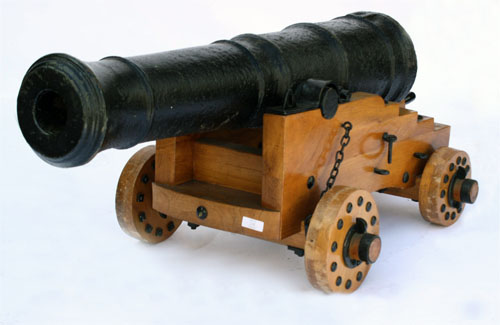
AN HISTORIC 2 7/8in. BORE IRON CANNON OF IMPORTANCE TO KING'S LYNN,
circa 1770, 50in. overall barrel length including the bulbous cascabel, five moulded bands not including the muzzle or breech, moulded touch-hole, the top of breech with a letter 'P' and possibly a number '9', unmodified trunnions, the whole mounted on an expertly re-produced elm naval carriage with iron furniture, elevation wedge and four bolted trucks
Other Notes: King's Lynn has long been a strategic point from a military perspective. Indeed, as long ago as 1587, the then Spanish Ambassador to London stated that the most convenient place for Dutch troops to land would be at Lynn as "there is a good harbour there, which can easily be fortified". Fortunately, neither the Dutch nor the Spanish ever attempted a landing or history as we know it might have been completely different today. However, by the later part of the 1700's a French invasion was becoming increasingly ever more likely, and in 1770 the sloop 'Despatch' landed 10 cannon from the Tower armouries to defend the edifice known as St Ann's Fort. Built originally back in the 15th century near the dock the 'fort' was strange in that it was devoid of any parapet, the idea being that should a war occur, the defect could be remedied by erecting walls of sand-bags etc. On the other hand, its positioning was brilliant in that no ship could enter harbour without passing the fort by first. The ten cannons landed were all given names, the first was the 'St. Ann', then there was the St. George, the St. Margaret, the St. Nicholas, the St. Mary, the St. James, the St. Cecile and the St. David. The final two were named 'Queen Boudica' and the 'Lynn Independent', the last after the artillery detachment that manned the fort. The garrison numbered 171 men, all volunteers, the 'one' being the officer in charge and they adopted a gaudy uniform consisting of dark blue regimentals, a scarlet waistcoat with light blue lapels and an orange cape. The flag they were to fight under bore the exhilarating effusion 'Watch round this land with Briton's eye, Your wealth defend, or bravely die: Feast on roast beef, plum pudding too, Then with good cheer the foe subdue.' Luckily the French never came, because the garrisons instructions should hostilities arise was that on hearing the artillery drum to make all haste to the fort arming themselves with picks and shovels (which they had to keep by themselves at all times) and build a wall to defend the garrison from enemy shot! It is unknown which of the ten cannon this is, but it has remained in civic and private hands since the disbanding of the fort.
Please click HERE to view Terms & Conditions.
Estimate £1,000-1,500