

Product Details
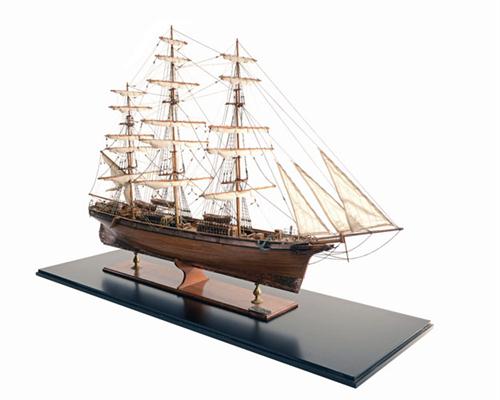
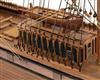
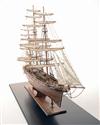
AN IMPRESSIVE, CASED WOODEN MODEL OF THE TEA CLIPPER "CUTTY SARK",
approx. 46in. overall including bowsprit and jib-boom with an approx. waterline length of 34in., of individual double-planked construction on wooden frames and floors with fittings in brass, lost-wax castings and hardwood, fully rigged with some headsails set along with a scandalised mizzen, the hull in satin varnish and copper-sheathed below the waterline, held on a wood base with brass and wood pedestals, the whole in a glazed case.
Provenance: Cutty Sark was one of the last tea clippers built, being commissioned by John 'Jock' Willis in 1869 and built in the yards of Scott & Linton of Dumbarton. She was a three-masted fully-rigged ship of composite construction (the hull of wood planking on iron frames) and considered one of the fastest of her time, second only to Thermopylae (although Cutty Sark could outsail her in heavy weather). She was named after Nannie Dee, the witch in Robert Burns' 'Tam o' Shanter', and depicted in majestic pose for the ship's figurehead. "Cutty Sark", Nannie's nick-name, roughly translates as short skirt in gaelic.
She was very successful on the China tea trade where enormous profits could be made by the ship first back to England with the season's fresh tea. It was at a time though when sail was slowly giving way to steam, and even though the early steam ships were not as fast as sail, the writing was on the wall. The Suez Canal opened the same year the ship was built and made the journey from China far quicker for the steam-powered vessels. This meant that the clippers were displaced and Cutty Sark went to the Australian wool market. It was here that her ability to press on in the heavy weather of the Southern Ocean really proved its worth and she was, arguably, the most successful ship in that trade recording one noon-to-noon passage of 363 nautical miles. Inevitably though the clippers were again displaced as steamers became more reliable, needing only a handful of crew and less expertise. This left only the Australian grain market where sail still reigned, but Cutty Sark was unsuited to that cargo.
She then transferred into Portuguese ownership and was re-named "Ferreira", carrying general cargo until being returned to British hands in 1922 when she was purchased by Wilfrid Dowman as a sea training ship. She remained in a training role (moored alongside for the most-part) until being preserved for the nation and transferred into a permanent dry dock at Greenwich. She is one of only three composite-hulled clippers remaining.
Please click HERE to view Terms & Conditions.
Estimate £1,800-2,200