

Product Details
GEORGE ADAMS, LONDON
A VICTORIAN SILVER TABLE-SERVICE, FORMERLY THE PROPERTY OF GEN. JOHN NEPTUNE SARGENT, C.B.,
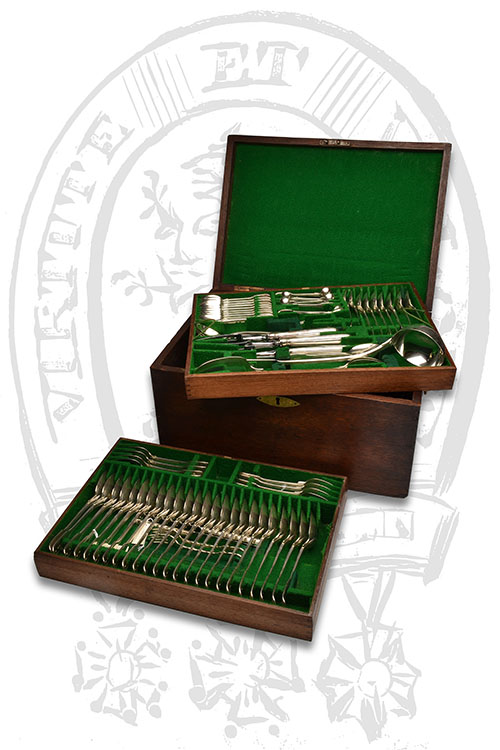
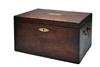
all of fiddle, thread and shell pattern, the majority with Adams' London marks for 1852 and comprising the following with stainless blades and filled handles; 36 table knives, 18 dessert knives, 3 carving knives, 3 carving forks and a steel, together with the following in silver; 36 four-prong table forks, 18 dessert forks, 24 table spoons, 18 dessert forks, 18 teaspoons, a soup ladle, a basting spoon, a fish slice, a pair of sauce ladles, a pair of sugar tongs, a butter knife, 4 salt spoons, a condiment ladle and a mustard spoon, the whole in a five-tiered oak canteen (key extant) with brass mounts and drop-handles, the canteen by R. & S. Garrard & Co. and with an inlet brass cartouche to the lid inscribed "COLONEL SARGENT, C.B. THE BUFFS"
Provenance: John Neptune Sargent was born of Irish descent on 18th June 1826 aboard the East India Company's fully-rigged ship 'Atlas'. His father was an officer in the 18th Royal Irish and the family were posted to the Far East; the climate didn't suit his father who died in Hong Kong circa 1844. The same year, Sargent purchased a commission in the 95th Foot, joining his regiment in Ceylon, before going on with it to Hong Kong three years later.
Sargent served in the Far East until his regiment were ordered to Turkey in 1854 where the allied armies of Britain, France and the Ottoman Empire were massed against the Imperial Russian Army. Sargent, by now a Captain, fought with great bravery and tenacity at the Battle of Inkerman the same year which, it can be argued, broke the will of the Russians and set them on the back-foot for the remainder of the Crimean War. Inkerman was fought largely in thick fog and led into the Siege of Sevastopol where Sargent was wounded in the final attack on the Redan on 8th September 1855. He was highly recommended by his Colonel as 'a most zealous, meritorious and brave officer' and was mentioned in dispatches. For his efforts he was awarded the Crimean Medal with three clasps, the Turkish Medal, the Medjidie (Fifth Class) and the Legion of Honour.
After eighteen months on half-pay, Sargent was given a majority in the 2nd Battalion of The Buffs before being promoted, becoming Lt.-Col. in the 1st Battalion in July 1859. He commanded his battalion during the China War of 1860. He returned home via Malta and was sold out of the regiment, again on half-pay in December 1864, by now a full Colonel. He held several posts over the next decade before returning to command the troops in China and the Straits Settlements - a difficult appointment made more complex by the war between France and China - where he did much for British interests in the region. His tenure was cut short as he was promoted to Lt.-Gen. in October 1864 and returned to England. He was retired out of the army in 1890 and died near Bexley on 20th October 1893.
His obit. in The Times read that he was "a man of great strength and tenacity, of kindly, leonine aspect, impetuous yet shrewd, he was an enthusiastic soldier".
Please click HERE to view Terms & Conditions.
Estimate £4,000-6,000