

Product Details
STARR ARMS CO. USA
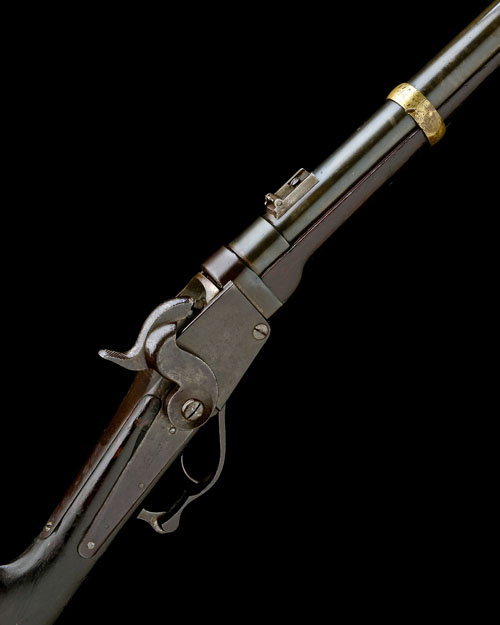
A .54 PERCUSSION CAPPING BREECH-LOADING SINGLE-SHOT CARBINE, MODEL '1858 CARBINE', no visible serial number,
circa 1863, with round tapering 21in. barrel signed 'STARR ARMS CO, YONKERS N.Y.', dove-tailed blade fore-sight, folding notch and 'battle' sight, square receiver with falling-block mechanism and saddle-ring mounted to left hand side, colour-hardened lockplate signed 'STARR ARMS CO, YONKERS N.Y.', large slab-sided hammer, the wrist of receiver marked 'STARR'S PATENT SEPT. 14TH 1858', walnut straight-hand butt-stock (repaired crack behind top-tang underneath comb), brass heel-plate and barrel-band and iron underlever forming the trigger-guard
Other Notes: By the end of the American Civil War, 20,602 Starr carbines had been supplied and were widely used on many battlefields. Possibly the most famous issue of the Starr carbine was to the Colorado Volunteers, commanded by the infamous Colonel Chivington. It was Starr and Sharps carbines that accompanied Chivington and the Volunteers to Sand Creek in late November 1864. Here they found the camp of Chief Black Kettle, a camp made up of mainly Cheyenne and Arapaho lodges, supposedly under the protection of the Union Fort Lyon. Chivington approached the camp accompanied by 700 men, a sight which had Black Kettle immediately gather many of his tribe under the American flag flying over his lodge, he also raised a white flag to show his peaceful intent. Chivington immediately ordered his men to open fire on the gathered Indians, mainly women and children as the braves were mostly out of the camp hunting. One Indian, White Antelope, ran towards the Union men shouting for them to stop but was instantly gunned down. Chivington wanted a victory, not to take prisoners. The gathered Indians scattered in panic but the crazed soldiers were unrelenting, charging and killing anything that moved. The hopelessly outnumbered Indians fought back bravely allowing a number of the tribe, including Black Kettle to escape, but at the end of the day over 200 Indians, mostly old men, women and children lay dead. An interpreter present at the scene later testified " The Col. was heartless...., the people of the village were slaughtered, they were scalped, their brains knocked out, the men using knives ripped open women, clubbed little children, knocking them in the head with their carbine butts, beating out their brains and mutilating them in every sense of the word."
Most Easterners were outraged by Chivington's actions, despite his claims that the Cheyenne's had been attacking white settlers, and after a Congressional enquiry he was reprimanded and forced to resign. This in no way appeased the Indians however, who after learning of the massacre hardened their resolve to resist white encroachment of their lands, and in turn condemned tens of thousands on both sides to die in the ensuing 25 years of conflict.
Please click HERE to view Terms & Conditions.
Estimate £800-1,200