

Product Details
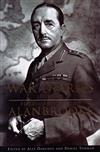
FORMERLY THE PROPERTY OF FIELD MARSHAL ALAN FRANCIS BROOKE
JOHN RIGBY & CO.
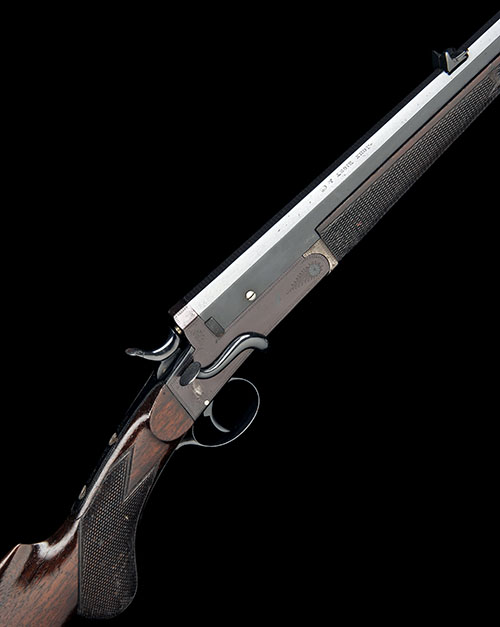
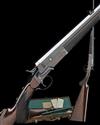
A .297/.250 SINGLE-BARRELLED SIDELEVER HAMMER ROOK RIFLE, serial no. 1771 / 2695,
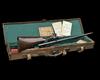
26in. octagonal barrel, the upper flats marked 'JOHN RIGBY & CO. 72 ST. JAMES'S ST. LONDON.' and the side marked with the calibre designation, matt top-flat with bead fore-sight and rear folding sights, beaded border and partial scroll engraving, central hammer, rebounding lock, the whole refinished except the 14 1/4in. semi-pistolgrip stock, in an 'ARMY & NAVY' canvas and leather case refitted for this rifle
Provenance: Field Marshal Alan Francis Brooke, 1st Viscount Alanbrooke, KG, GCB, OM, GCVO, DSO & Bar (23 July 1883 - 17 June 1963) was Chief of the Imperial General Staff during the Second World War, and was promoted to Field Marshal in 1944. As chairman of the Chiefs of Staff Committee, Brooke was the foremost military advisor to Winston Churchill, and had the role of co-ordinator of the British military efforts in the Allies' victory in 1945.
Born in 1883 in Bagneres de Bigorre, France, Alan Francis Brooke was the sixth son and ninth child of Sir Victor Brooke and Alice Bellingham Brooke. At the age of 18 he entered the Royal Military Academy at Woolwich, and joined a battery of Royal Field Artillery in Ireland in 1902. In 1906 he joined the Royal Horse Artillery, and three years later he was posted to India, where he proved to be a highly efficient and skilled officer.
During World War I, Brooke was commanding Canadian and Indian artillery units on the western front. He fought in the battle of the Somme where he introduced the French "creeping barrage" system, which helped in the protection of the advancing infantry from enemy machinegun fire. Brooke ended the conflict as a Lieutenant Colonel with the Distinguished Service Order and Bar.
Between the wars Brooke lectured at the Staff College and the Imperial Defence College, where he knew most of those who became leading British Commanders of the Second World War. In 1938, on promotion to lieutenant-general he took command of the Anti-Aircraft Corps (renamed Anti-Aircraft Command in April 1939) and built a strong relationship with Air Marshal Hugh Dowding, the AOC-in-C of Fighter Command, which laid a vital basis of co-operation between the two arms during the Battle of Britain. In July 1939 Brooke moved to command Southern Command. By the outbreak of the Second World War, Brooke was already seen as one of the army's foremost generals.
Following the outbreak of the Second World War, Brooke commanded the Second Corps of the British Expeditionary Force, which failed to stop the German invasion. He played a major role in the Dunkirk evacuation, in which he was credited in providing the vital defences that allowed the troops to be evacuated by naval vessels. In the German offensive in late May 1940, the Second Corps found its left flank exposed by the capitulation of the Belgian army. Brooke swiftly ordered the 3rd Division to switch from the Corps' right flank to cover the gap. This was accomplished in a complicated night-time manoeuvre. Pushing more troops north to counter the threat to the embarking troops at Dunkirk from German units advancing along the coast, II Corps retreated to Dunkirk where on 29 May Brooke was ordered to return to England, leaving the Corps in Montgomery's hands. According to Montgomery, Brooke was so overcome with emotion at having to leave his men in such a crisis that "he broke down and wept".
Shortly after the evacuation from Dunkirk he was again sent to France to take command of the remaining British troops in the country. Brooke soon realised that the situation was untenable and in his first conversation with Prime Minister Winston Churchill he insisted that all British forces should be withdrawn from France. Churchill initially objected but was soon convinced by Brooke and around 200,000 British and Allied troops were successfully evacuated from ports in northwest France.
In late 1941, Churchill asked Brooke to become Chief of the Imperial General Staff (CIGS). During his time as CIGS, Brooke had a tumultuous relationship with Winston Churchill. Brooke was often frustrated with Churchill's habits, working methods, and constant 'meddling' in strategic matters. Equally he greatly admired Churchill for his inspirational leadership. In a passage in Brooke's war diaries Churchill is described as a "…genius mixed with an astonishing lack of vision - he is quite the most difficult man to work with that I have ever struck but I should not have missed the chance of working with him for anything on earth!". Churchill said of Brooke: "When I thump the table and push my face towards him what does he do? Thumps the table harder and glares back at me. I know these Brookes - stiff-necked Ulstermen and there's no one worse to deal with than that!". Despite their many disagreements Brooke and Churchill had a great respect, and held an affection for each other.
Alan Brooke had a love of nature. Hunting and fishing were among his great interests. His foremost passion, however, was birds. Brooke was a noted ornithologist, especially in bird photography. He was president of the Zoological Society of London from 1950-54 and vice-president of the Royal Society for the Protection of Birds
Other Notes: This Lot is accompanied by two period firearm certificates dated for 1920 and 1939, with the holder of the licence as 'Lt. Co. A.F. Brooke' (1920) and 'Lieut. General A.F. Brooke' (1939). This rook rifle is recorded in both licences.
Please click HERE to view Terms & Conditions.
Estimate £500-700