

Product Details
WILLIAM EVANS
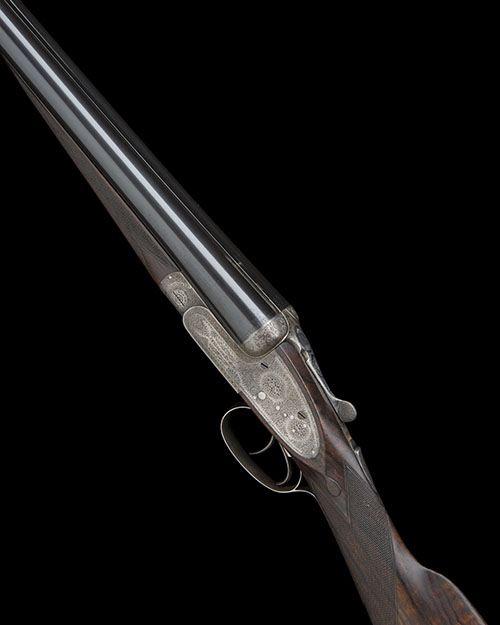
A 12-BORE SIDELOCK EJECTOR, serial no. 8056,
28in. nitro barrels, rib inscription faint, gold-inlaid '1' at the breech end, 2 1/2in. chambers, bored approx. imp. cyl. and 1/4 choke, right wall at 19, treble-grip action with hidden third bite, toplever gold-inlaid '1', automatic safety with gold-inlaid 'SAFE' detail, fine acanthus scroll engraving with floral bouquets, retaining very slight traces of original colour-hardening and finish, right ejector requires attention, 14 1/2in. figured stock including 7/8in. rubber recoil pad, weight 6lb. 8oz., in a leather case
Provenance: The makers have kindly confirmed that this gun was completed in 1903 with 28in. barrels for E.S. Hervey.
The vendor has kindly provided us with some additional information on the history of the gun:
(The gun) was given to me some 20 years ago in the mid nineties by my late and much loved "godfather", thespian Hugh Latimer, some time after he himself had given up shooting - and I also like to think out of his fondness and perennial generosity to me. Although it's a sporting gun, I used it mainly for clays, which I much enjoyed having been introduced to the sport years earlier by a great friend (and erstwhile coach) in Atlanta who had been a US Olympic shooter from way back and is now on the "Iron Man" Board at Bisley!
I myself gave up shooting around the same time I retired from Historic motor racing after some 30 years, many of which were shared as co-driver with Sir Stirling Moss in our joint and rare OSCA Maserati cars from the 50s. Stirling retired around the same time when we were both at Le Mans for the Legends Race in 2012.
Hugh's younger daughter, Clare, an outstanding culinary star and a lifelong friend, was the Downing Street chef for many years (including during the John Major era when she had been unfairly, mischievously and unknowingly embroiled as a diversionary tactic in the Major/Curry affair) and earlier today, I asked her for any information she might have about the earlier history of 8056 when her father owned it. She was able to confirm that Hugh had himself inherited it from his stepfather, Sir Alexander James Anderson - hence the initials "AJA" engraved on the shot gun. Sir Alexander had been one of the heroes of the disastrous Battle of Kut in 1916 in Mesopotamia (Iraq today) and spent the remainder of the Great War as a prisoner of the Ottoman Empire, Some time after the war he went to live in Burma (now Myanmar) and retired as Vice-Chairman of the Port of Rangoon before he died in the mid nineteen sixties.
Sir Alexander J Anderson 1879 - 1965
During the Great War Sir Alexander J. Anderson was a Major, RFA (Royal Field Artillery), serving in Mesopotamia.
Before his death he had been Vice-Chairman of Commissioners for the Port of Rangoon, having moved to live in Burma (now Myanmar) between the wars.
His private papers are held in the Imperial War Museum and at Leeds University. The papers in the latter were placed in the collection by his stepson, Hugh Latimer, and are recorded as such
Among the papers at the IWM is the diary Sir Alexander had kept while he was a Major commanding the Volunteer Artillery Battery, Indian Army, in Mesopotamia during September 1915 - April 1916. The Battery was involved in the defence of Kut and the diary consists of full daily entries describing Turkish infantry assaults, shelling and air raids on the town. References include details of the truce arranged by the Turks to bury the dead, the failure of British relief attempts which had raised the hopes of the besieged soldiers, many of whom subsequently died in captivity, the shortage of food and attempts to supply the garrison by air and river, and the bad weather conditions which bedevilled the defenders, and a full breakdown of the forces defending Kut. Also held with the diary are a series of 22 letters dated from July 1915 to November 1918, written home mainly to his sisters and chiefly during his time as a prisoner of war in Turkey, together with a notebook kept during August 1916 to August 1917 while a PoW of the Turks in Castemoni prisoner of war camp, including brief notes on conditions in the camp and various jottings, sums and lists of supplies.
Please click HERE to view Terms & Conditions.
Estimate £1,200-1,600
S2