
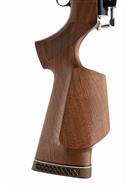
Fine Modern & Antique Guns - December 2017 : Sale A1217 Lot 525
F. DUNCKEL, BURG LINN, GERMANY AN EXCEPTIONALLY FINE 28-BORE PERCUSSION CAPE-RIFLE WITH GILT DECORATION, no visible serial number,

Product Details

* F. DUNCKEL, BURG LINN, GERMANY
AN EXCEPTIONALLY FINE 28-BORE PERCUSSION CAPE-RIFLE WITH GILT DECORATION, no visible serial number,
circa 1845-50, with brushed bright fine twist damascus 28in. barrels, the right rifled in seven grooves, the left smooth, the contrasting damascus top-rib with inlaid panel signed in gold 'F. DUNCKEL BURGLINN', blacked niello borders either end of the signature, dove-tailed broad based blued fore-sight with crescent blade, blued rear-sight with numbered register for windage adjustable via a screw and lockable via another, the front of sight base carved as a running snake, colour hardened rib-end with contrasting engraved borders, colour hardened breech-blocks, the snails shaped and moulded and carved in relief as a flower, the central vents in platinum, the undersides with oval makers marks 'MST', blued nipples with polished tops, fully chased and engraved complex top-tang with curled percussion fences to the fore, the relief engraving further enhanced with a gilded eagle between the hammers, a broad panel with a stag in a woodland setting against a gilded background with further gilt accents to the remainder, fully carved and engraved back-action locks with engraved extended underbarrel supports, the engraving featuring relief carved acanthus scrolls inhabited with gilt game animals, birds and flowers, polished exposed pin-heads, fully carved and engraved swinging safes forwards of each hammer, each inlaid with a gold line, relief carved, pierced and engraved hammers with engraved dome-headed screws, the back curves pierced with bows and arrows, the bodies inhabited by gilded mythical beasts, the hammer heads carved as dragons with gilt eyes, teeth and realistically carved hair, finely chequered hammer spurs, figured walnut straight-hand half-stock finely chequered at the wrist, the right hand side relief carved with a panel of acanthus scrolls and a border of oak-leaves surrounding a complex pierced patch-box and hinge, the front of the panel with applied eagle in bone clutching a fawn in its talons, the lid of the leather-lined patchbox relief carved with a gilt hunter stalking a gilded mouflon in a mountainous setting with small detail also picked out in gilt, the left hand side of butt with moulded and raised cheek-piece, the rear deeply relief carved with a scene of hunting dogs attacking wild boar in a woodland setting whilst a hunter stands by with his hanger waiting to administer the 'coup de grace', the trees inhabited by an applied gamebird in bone, iron heel-plate, the long top-spur carved en-suite with the locks, moulded and carved horn lower tang cover with pistol-grip spur, carved and engraved complex trigger-guard bow featuring a gilded fox and a multiple curled scroll leading edge, blued set trigger for the right hand barrel, plain blued trigger for the shot barrel, long carved, chased and engraved trigger-guard complex finial with gilded detail almost meeting the en-suite complex ramrod throat, rectangular gilt barrel key escutcheons, silver mounted ebony under-barrel ramrod and front and rear blued sling-swivels

Other Notes: Formerly in a Dutch province belonging to William Of Orange, Burg (or Castle) Linn is in the city of Krefeld, now part of Germany

The extraordinary attention to the detailed chiselled and carved decoration of this rifle is in close keeping with the finest luxury firearms made in Vienna and Prague, circa 1850-60. Examples of this school of workmanship are found in the majority of the surviving ancestral gunrooms of the crowned heads of Northern Europe and Scandinavia, and those of the German and Austro-Hungarian senior nobility. Leading exponents of this elaborate style include Anton Vinzenz Lebeda of Prague and Matthias Novotny of Vienna; examples of their decorated sporting guns made for the Habsburg Court are preserved in the Hofjagd und rüstkammer, Vienna. See Schedelmann 1972.

The incorporation of alpine sporting subjects within the decorative scheme of the present rifle confirms that it was intended for use within the rich game region of the South German alps.

Provenance: Canadian private collection

Reference: Hans Schedelmann, Die großen Büchsenmacher, Braunschweig 1972


* Please note this item is subject to 5% VAT on the hammer price.

Please click HERE to view Terms & Conditions.

Estimate £8,000-12,000